














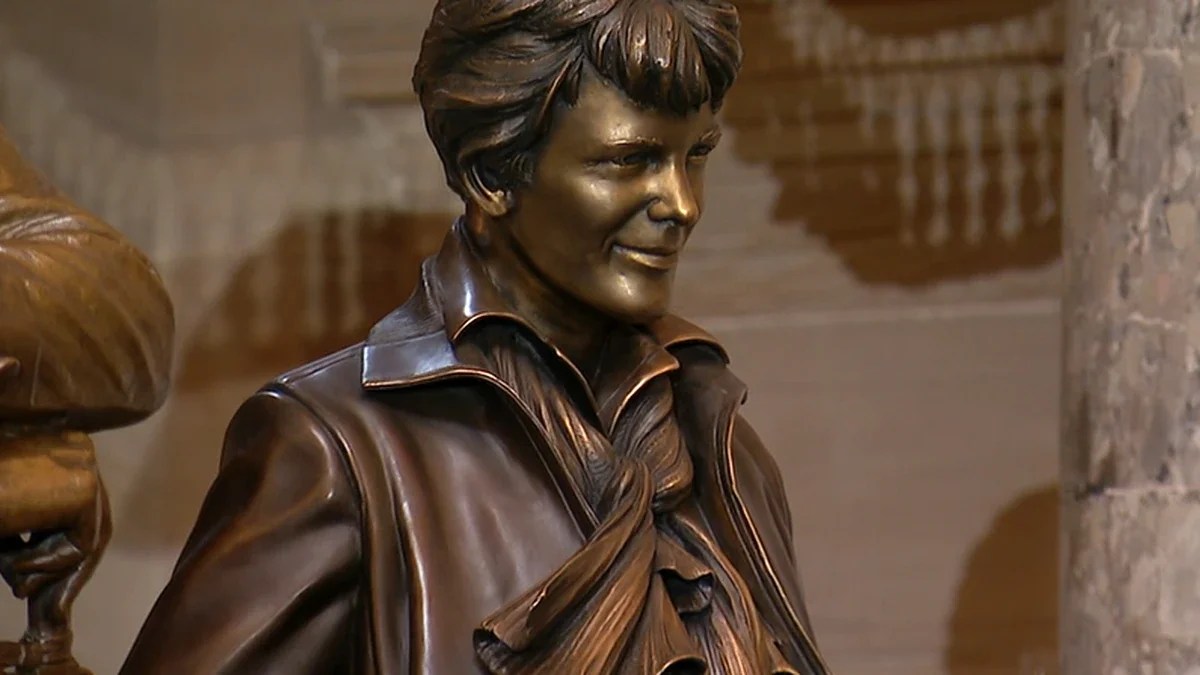

Just three days after what would have been her 125th birthday, a statue of Amelia Earhart was unveiled in the U.S. Capitol’s Statuary Hall on Wednesday. Her likeness joins 34 other statues in the hall and was placed between Thomas Edison and Chief Standing Bear, a native civil rights leader during the 19th century.
At least in time, Earhart’s trip to the Capitol was longer than any flight she ever flew, starting in 1999 when the Kansas legislature voted to have her statue replace that of Kansas Senator John James Ingalls, who stood in the hall since 1905. It took private interests several years to raise the money to have the statue commissioned, according to reporting by the Kansas City Star. Some 200 designs were submitted before one was approved for casting by George and Mark Lundeen. It depicts her in trousers, a pilot jacket and a scarf.
She has a leather hat and goggles in one hand and a Kansas sunflower on her belt.
Earhart grew up in Atchison, Kansas, and later Des Moines, Iowa. She achieved fame as the first woman and only the second person to fly solo across the Atlantic in 1932. That same year, she flew nonstop from Los Angeles to Newark, New Jersey, in 19 hours. In 1937, she disappeared without a trace when attempting a global circumnavigation with navigator Fred Noonan in a Lockheed Electra.
