















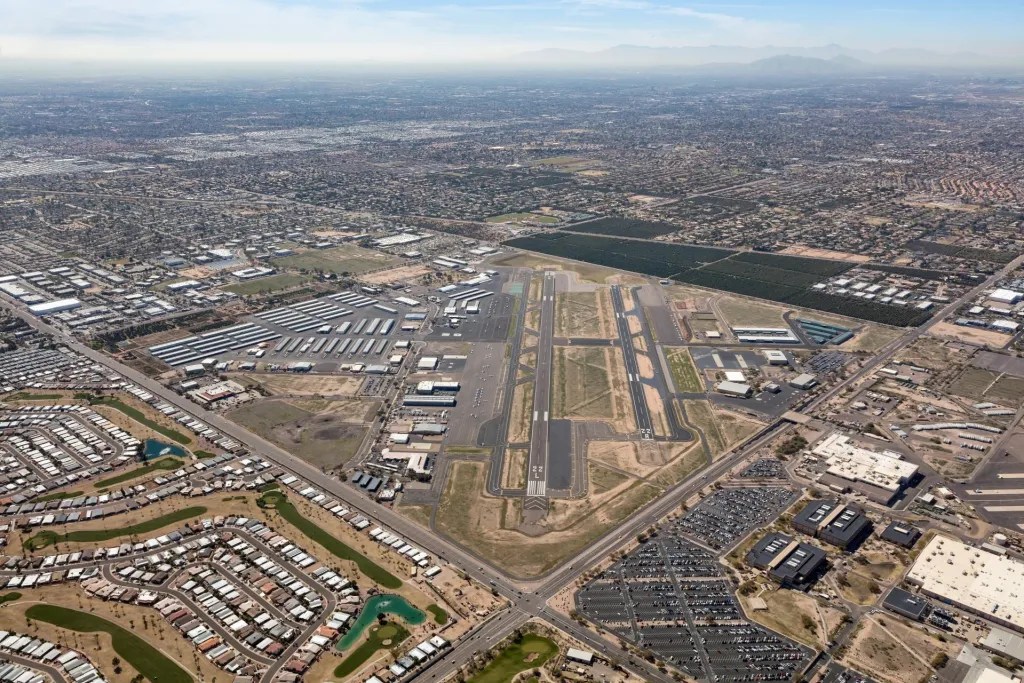

The FAA is urging Mesa, Arizona, officials to delay Falcon Field’s new landing fee schedule while the agency reviews complaints filed over the program. The April 13 letter, which was made public about two days ago according to a field stakeholder, was sent by the FAA’s Office of Airport Compliance and Management Analysis to Mesa Mayor Mark Freeman, City Manager Scott Butler and Falcon Field Airport Director Corinne Nystrom.
FAA Raises Concerns
“At this time, based on publicly available information, we have significant concerns that the proposed landing fee structure may be inconsistent with the City’s Federal obligations, both grant assurances and Surplus Property Act conveyance obligations,” the FAA said in the letter. “The City’s landing fees structure may unreasonably interfere with, or limit, legitimate aeronautical activities. Any attempt to limit operations or specific types of operations, through landing fees, is not permissible.”
The FAA said at least two informal complaints had been filed under 14 CFR Part 13.2. The agency said the fee structure may conflict with several grant assurances, the FAA’s Rates and Charges Policy and, depending on the aircraft involved, the Airport Noise and Capacity Act and 14 CFR Part 161. The letter also cited possible impacts to air traffic management and efficiency in the Phoenix area, including diversions, go-arounds and pattern saturation.
AOPA Seeks Stay
AOPA also sent a May 28 letter to the FAA asking for an immediate stay on the fees until Mesa conducts a review and publicly shares an economic impact analysis. The association said the city intends to use ADS-B data to collect the fees and raised concerns over the effect of that approach on airport safety.
Mesa approved the fee schedule March 23. The schedule sets a $20.35 fee per landing for based fixed-wing aircraft at or below 6,000 pounds maximum landing weight and $24.35 per landing for itinerant fixed-wing aircraft in the same category.
Falcon Field had previously delayed implementation from May 1, and Mesa has said it plans to activate the collection system July 30 and begin collecting landing data for billing purposes Aug. 1.
Falcon Field leadership could not be reached for comment.


Besides misusing ADS-B data, the excessive landing fee is a clear indication of what kind of traffic the airport wants. Corporate jets spend a lot more money on fuel than small aircraft. The wealthier clients who own them are more welcome and less concerned about the landing fee. I wouldn’t land my Maule at an airport to get fuel or stay overnight with a $20+ landing fee. Selectively discouraging small transient aircraft is against Grant Assurance 22 if the airport is accepting Airport Improvement Program grants.
The FAA has paid for the paving of nearly all commercial runways and probably at least half of the class E airport runways in the US; with the stipulation that charges for airport runway use can not be done. This is very strait forward! How can any airport challenge this? Are these people at Mesa a bunch of children and have not read the stipulations for the last repaving of the runways at Mesa? This is a wake up moment for Mesa, AZ, airport, with FAA legal telling them the actual story since they do not appear to know they can not charge for use of a runway! Where is the court order against this Mesa, Arizona airport action?
Great arguments. That said, how is it that BOS can restrict transient GA to PPR, charge obscene landing and ramp fees. As has been pointed out, the FAA has put money into all these airports.
Kudos to PHL. Fees are still reasonable. Not every light GA pilot needs or wants to go in to a primary Class B airport. But, within reason, we should have the ability without crazy and restrictive fees and policies.
As for Mesa, they don’t have to worry, I won’t inconvenience them as a transient to spend my money for a fuel stop there.