









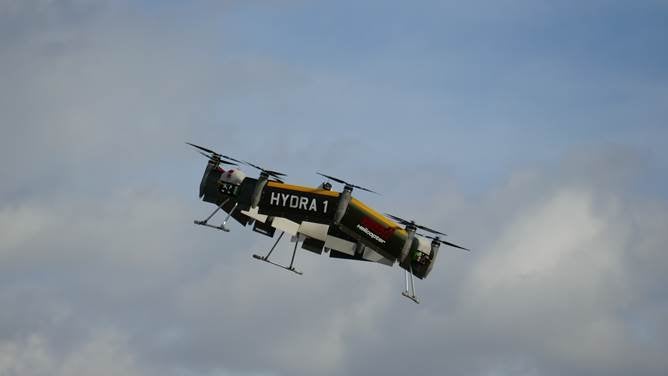
Bell Helicopter demonstrated its unmanned Hybrid Drive Train Research Aircraft (HYDRA) at the first Tech Demo edition of the Unmanned Aircraft Systems (UAS) Center of Excellence in Alma, Quebec, this week. According to the company, HYDRA uses distributed propulsion technology and a circular wing to “sustain wing-borne flight at reduced power consumption, while increasing its speed and range over a traditional multi-rotor aircraft.” The demonstration flight lasted for 40 minutes and ran through automated maneuvers including takeoff, conversion into wing-borne flight, conversion into hover mode and landing.
Bell hopes the research done with HYDRA will eventually allow the company to develop passenger transports and large unmanned aircraft that use distributed propulsion technology. “HYDRA has already proved to be a great teacher,” the company said. “Our team has discovered the unexpected stability of a circular wing in flight and certain control laws that allow aircraft stability in VTOL mode, airplane mode, during transition and even in the event of a system failure.” HYDRA is also being used to study new hybrid propulsion technologies such as electric and fluid dynamic power systems.