















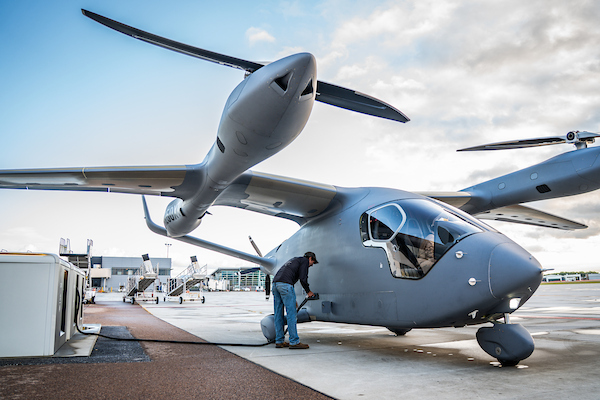

The Federal Aviation Administration (FAA) authorized BETA Technologies to conduct market survey flights with its ALIA A250 electric vertical takeoff and landing (eVTOL) aircraft, allowing prospective operators to evaluate the aircraft ahead of commercial operations.
U.S. Transportation Secretary Sean Duffy announced the special airworthiness authorization Wednesday, marking the first of its kind for an electric VTOL aircraft. The approval allows BETA to demonstrate the A250 to operators and other potential customers, subject to FAA limitations.
BETA founder and CEO Kyle Clark said the authorization will help operators assess how the aircraft could fit into their businesses, including transporting passengers and cargo between communities. He called it an important step toward commercial adoption and highlighted the company’s earlier milestones with its conventional takeoff and landing (CTOL) and VTOL aircraft.
BETA completed its first flight under the new authorization Oct. 20. The A250 departed vertically from Plattsburgh International Airport in New York, transitioned to wing-borne flight and landed vertically at Patrick Leahy Burlington International Airport in Vermont. The 34-nautical-mile flight took 20 minutes.
The A250 is designed to operate from locations with or without runway access. BETA says the aircraft can carry up to five passengers or more than 1,200 pounds of cargo. Potential applications include passenger transportation, cargo delivery, medical transport and defense. The aircraft shares propulsion systems, batteries, flight controls and charging technology with BETA’s conventional takeoff and landing ALIA model.
The authorization does not constitute full type certification or approval for scheduled commercial passenger service. BETA is continuing to work toward those milestones while using demonstrations to help prospective operators evaluate the aircraft’s capabilities and potential uses.
“The FAA is committed to working with American innovators to safely integrate these new aircraft into our national airspace,” FAA Administrator Bryan Bedford said in the agency’s announcement.


0 replies