
















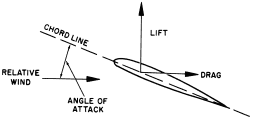
A report on approach and landing loss-of-control accidents has emerged from a work group co-chaired by the FAA and AOPA, recommending that GA “embrace to the fullest extent” angle-of-attack (AOA) systems and work to improve pilot decision making. Theworkgroup advises the General Aviation Joint Steering Committee. Its focus was derived from an FAA overview that found loss of control accounted for 40.2 percent of fatal general aviation accidents that took place from 2001 to 2010. Particular areas of concern included flying after a period of inactivity and transition training, as well as pilot decision-making.
Pilot decision-making remains a focus of safety concerns in general, as 85 percent of fatal accidents can be traced to pilot actions, according to AOPA. The report notes that controlled flight into terrain accidents have decreased and it attributes that improvement to new in-cockpit technology like terrain-aware GPS units. AOA systems, says the report, offer pilots awareness of their margin over stall and account for weight and acceleration differences, by design. The report notes that AOA systems offer substantial safety benefits but notes that cost and regulations may produce barriers for the pilots of light aircraft. The FAA “will need to identify the right level of certification,” it says. It notes that the FAA should address these issues “with streamlined processes” for certifying and installing new technology that offers “a high probability of safety benefits” balanced against “low safety risk.”Find the full report, here (PDF).

