















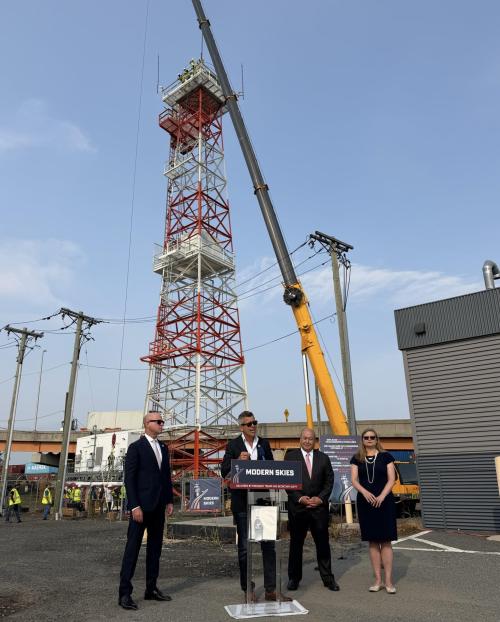

The Federal Aviation Administration installed a new surface movement radar at Newark Liberty International Airport, as part of its effort to modernize the nation’s aging air traffic control infrastructure.
Transportation Secretary Sean Duffy and FAA Administrator Bryan Bedford unveiled the new Surface Movement Radar Model 4 (SMR-4) on Tuesday, saying the system will give controllers a clearer picture of aircraft and vehicle movements on the airport surface, particularly during darkness or low-visibility conditions.
The radar replaces equipment that had been in service for roughly three decades. According to the FAA, Newark is the fifth airport to receive the new technology as part of a broader deployment that will place 53 surface movement radar systems at 44 of the nation’s busiest airports. The rollout is expected to be completed by 2028.
Unlike conventional airport surveillance systems, the SMR-4 is designed to provide controllers with improved situational awareness during poor weather, when visual observation from the control tower may be limited. Officials said the upgraded radar offers greater reliability while helping reduce the risk of runway incursions and ground collisions.
“Newark sees well-over a thousand flights per day, and the new Surface Movement Radar will help controllers keep those flights safe at this major U.S. hub,” said FAA Administrator Bryan Bedford. “This is just the latest step in the FAA’s work to modernize our skies for the Golden Age of Travel.”
The announcement comes as the FAA continues facing scrutiny over infrastructure reliability following several high-profile equipment outages and recent runway safety incidents. Officials say modernizing surveillance and communications systems is intended to improve both operational efficiency and safety as air traffic demand continues to grow.
Meanwhile, the agency reported a decline in runway incursions during the current fiscal year, a trend officials say reflects a combination of new technology, operational improvements, and ongoing safety initiatives.

0 replies