
















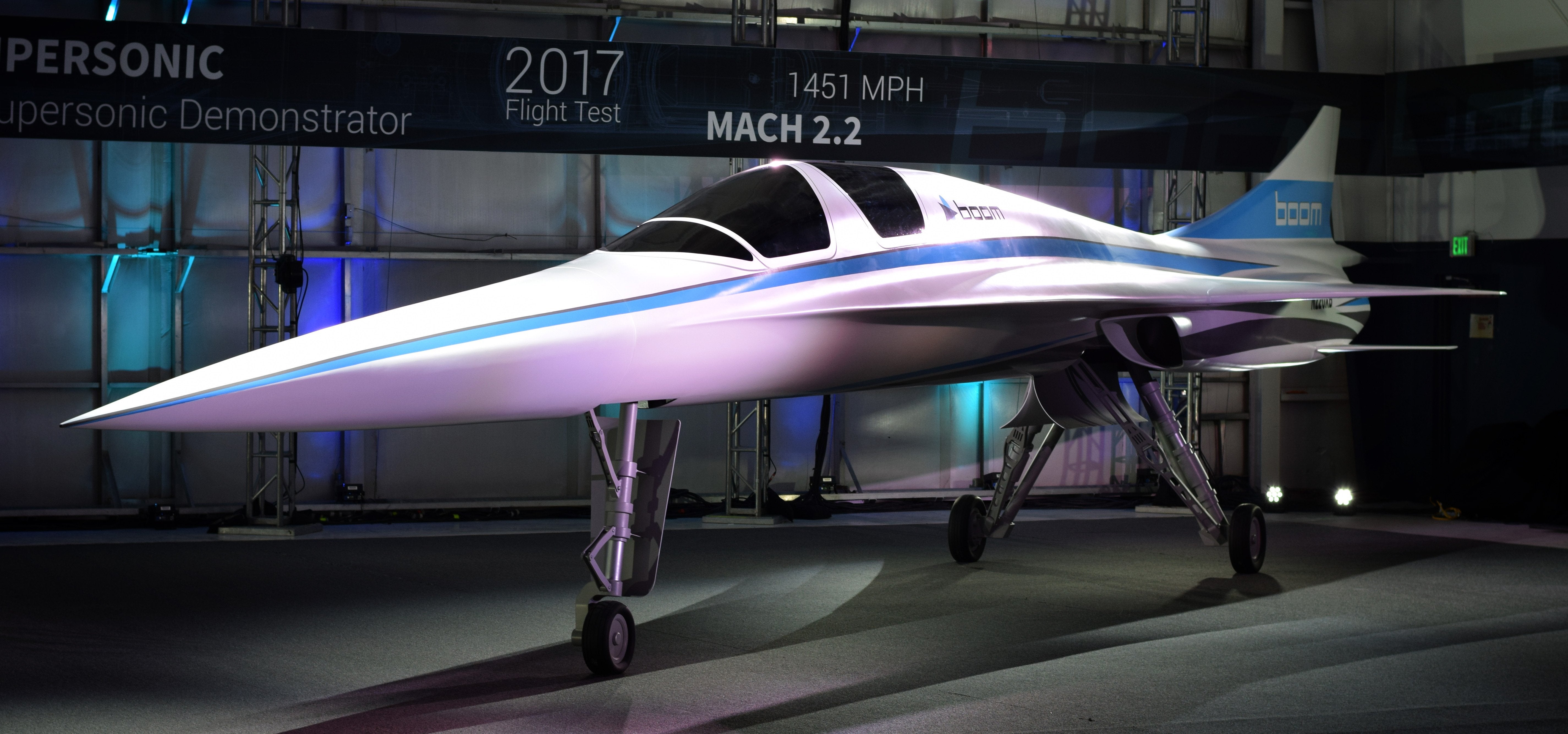
Centennial Airport based Boom Technology, would-be maker of the first supersonic airliner since the Concorde, has raised an additional $33 million to fund development of its one-third-scale demonstration aircraft, the XB-1, according to a company press release. An SEC filing on Tuesday reported that the company had raised $41.9 million, though $7.9 million of that probably reflects a restructuring of amounts previously raised. Boom CEO and founder Blake Scholl says “our mission is to make supersonic flight a reality,” and expects to see the XB-1 close to ready to fly in the next year. If successful, Boom says the XB-1 will be the first independently developed and privately funded supersonic jet (the Concorde was heavily subsidized by the French and British governments) and the fastest civil aircraft ever, cruising at Mach 2.2. Virgin Galactic’s SpaceShip Two is faster, but is classified as a rocket rather than an aircraft due to its non-air-breathing engines.
Boom asserts the final production aircraft will be capable of carrying passengers at costs comparable to business-class on modern wide-body jets. Boom has also indicated that they are attempting to significantly reduce the damage and nuisance caused when the high-pressure wake of a supersonic aircraft reaches the ground—the sonic boom. FAA regulations do not generally permit supersonic flight by civil aircraft over land, though testing of supersonic aircraft is permitted in military operations areas with prior permission. Boom is likely hoping to reduce their noise signature sufficiently to permit transcontinental flight, which would significantly broaden the potential market for supersonic travel.

