















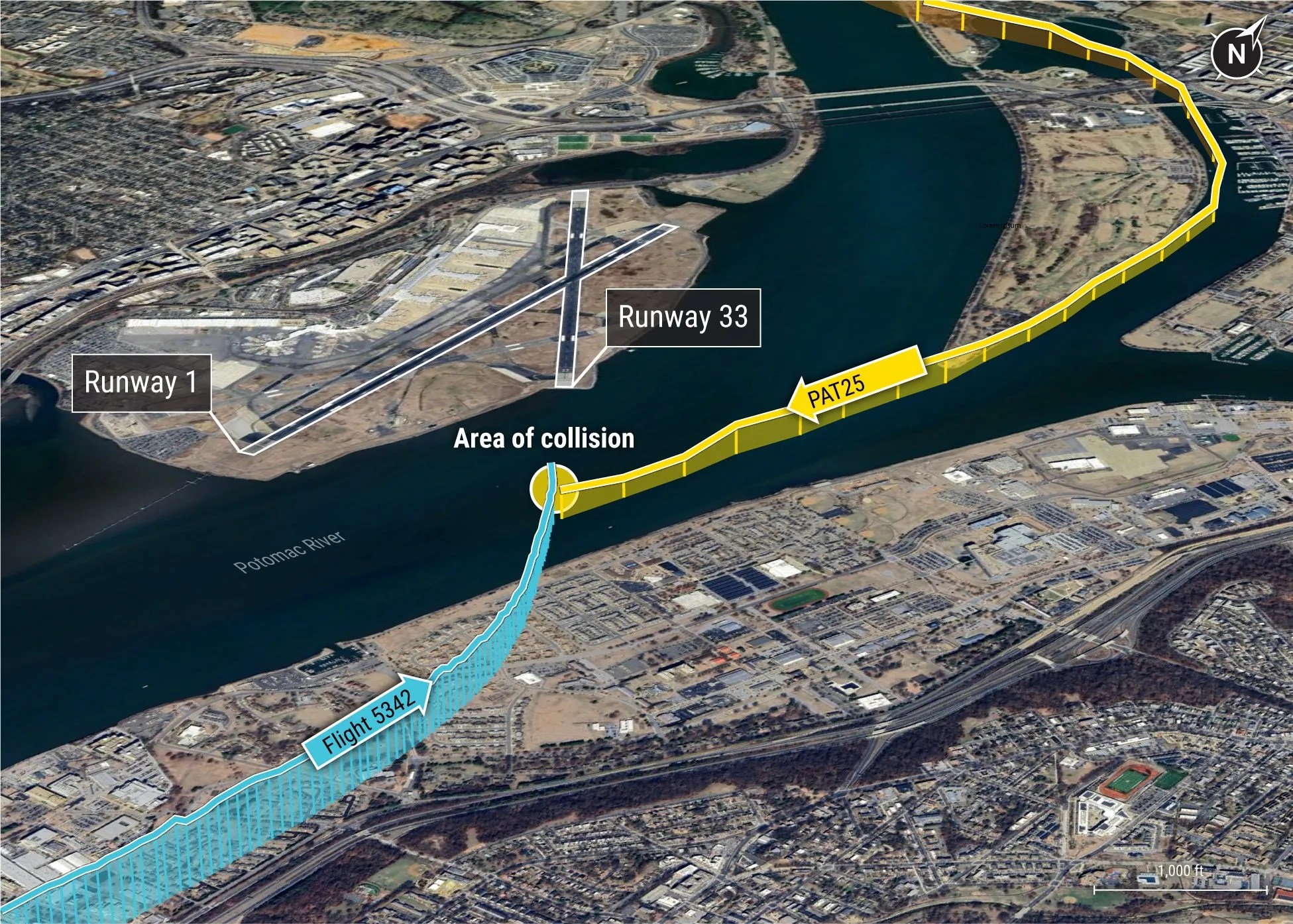

The U.S. Army released findings Thursday from its investigation into the January 2025 midair collision between an Army Black Hawk helicopter and a regional jet near Ronald Reagan Washington National Airport that killed 67 people. The investigation, completed in May, identified multiple safety failures involving air traffic control communications, helicopter operations and military oversight.
Communication and Altitude Failures
Investigators identified two broken radio transmissions as a key contributing factor that prevented the helicopter crew from receiving critical traffic information. The report also cited inaccurate altitude indications, limited visibility while using night-vision goggles and deficiencies in pilot training. Investigators found that the Black Hawk’s ADS-B Out equipment was improperly configured and had not been transmitting aircraft position data.
“In agreement with the NTSB, the inability to hear clear and concise radio transmissions did directly contribute to the accident,” the Army report stated.
Army Outlines Safety Changes
The investigation also found that the Army had not adequately tracked near misses or coordinated with the FAA to identify recurring hazards around Washington. Investigators noted that the helicopter route could provide as little as 75 feet of vertical separation from aircraft approaching Reagan National’s secondary runway. The findings reinforce the NTSB’s conclusions, which identified failures in FAA airspace design and safety management as primary causes of the collision.
In a fact sheet, the Army said it had inspected 3,585 helicopters for ADS-B configuration issues and introduced recurring inspections to verify proper operation. The service has also expanded training on fixed-wing approach and departure paths at Reagan National Airport and is pursuing an agreement to share safety data with the FAA. Other changes, including additional flight-data monitoring and updates to helicopter operating manuals, remain underway.


0 replies