
















As autonomous flight systems edge closer to real-world operations, researchers at the Georgia Institute of Technology are turning to one of general aviation’s most familiar tools: the CTAF radio.
A Georgia Tech research team has developed a system that allows autonomous aircraft to interpret pilot radio calls at non-towered airports and use that information to better predict the movements of nearby aircraft. The aim is to improve separation and situational awareness for future uncrewed aircraft without requiring changes to how pilots already communicate.
The project was presented at the IEEE International Conference on Robotics and Automation this month. Researchers said the underlying idea is straightforward: if human pilots use radio calls to build a mental picture of traffic in the pattern, autonomous systems should be able to do the same.
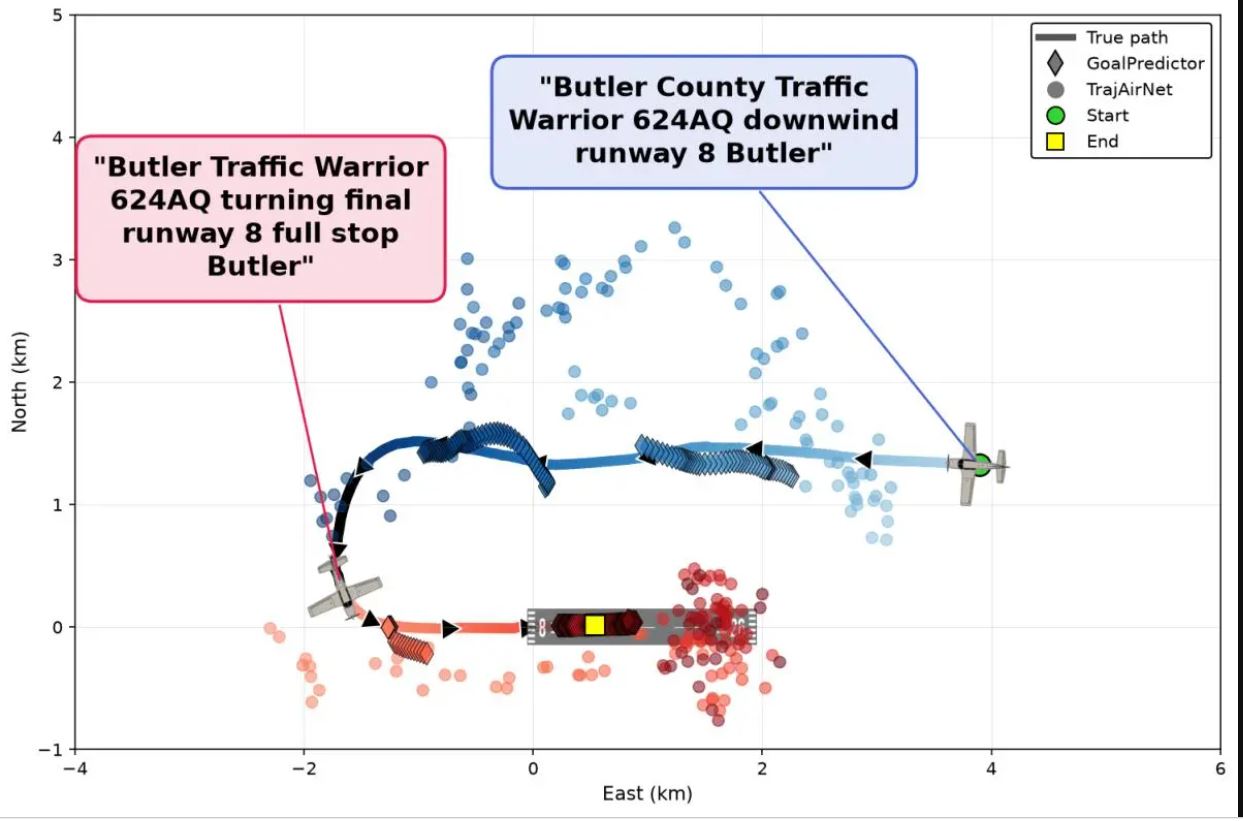
To test the concept, the team analyzed recorded radio transmissions and flight data from a non-towered airport in Pennsylvania. The system converts pilot calls into text, interprets the likely intent behind those calls, and combines that information with live aircraft tracking data. According to the researchers, adding radio data reduced average trajectory prediction error from nearly one kilometer to roughly 400 meters—a reduction of more than 50% compared to models that rely on position data alone.
Researchers say the approach could be particularly useful as autonomous cargo aircraft, drones, and other uncrewed systems begin integrating into the existing airport network, especially at smaller regional and general aviation fields. Rather than introducing new procedures for pilots, the system is designed to work within today’s CTAF-based environment.
Beyond autonomy, the work could also support new safety tools for non-towered operations. The researchers suggested similar systems could one day monitor both radio traffic and aircraft movement in real time, flagging potential conflicts or developing traffic situations before they become hazardous.
The next step is moving beyond interpretation of pilot intent. The team is now exploring whether autonomous aircraft could eventually generate their own CTAF-style position reports, allowing them to broadcast intentions and coordinate with human pilots using the same communication structure already standard at non-towered airports.

Years ago I was coming into a non tower airport for a fly in event. I was listening to the ctaf frequency 20 + miles before i got there. To figure out what runway was in use, wind direction and speed, etc. As i was preparing for a landing, a king air tried to pull a straight in approach on the opposite end of the active runway. I quickly got on the radio, and informed him of said active runway. Now would think that another pilot would be doing the same thing. Monitoring the ctaf, especially going into a fly in event. Or if he was on an ifr flight, atc would have given him that information. Regardless, it certainly pays to use ctaf.
What are all the dots off course, and the wigging worms especially the red one?
Report him for license cancellation.
AI is going to have a really hard time interpreting all of the non-standard gibberish transmitted on CTAF (my personal pet peeve is saying “traffic” at the end of the transmission).
Larger single engine and multi engine aircraft fly lower, near the ground compared to light single engine aircraft in airport traffic areas. Which makes them hard to see, if one can see them at all in taking a runway for landing. Cirruses seem to be notorious for doing this: long, strait in approaches and not visible; and close to the ground; where trees surround the class E airport. Announcing departure intentions on the CTAF may or may not get their attention. The last time it happened to me, the Cirrus pilot swore on the CTAF at me. I gave him the finger. Anywhere trees surround the approach end of the runway and the complex aircraft fly low to the ground, is an accident waiting to happen at class E airports. Class E airports are for small, light weight, LSA style aircraft. And not for complex aircraft. Please tell all complex aircraft drivers to follow protocol and pass over the airport before entering the pattern, so they know if anyone is either heading toward the active runway or there to take off. These lazy lard butt complex aircraft operators who refuse to follow the rules are the problem. Again, it is a necessity to check runway activity before setting up a landing at any class E airport!!!