















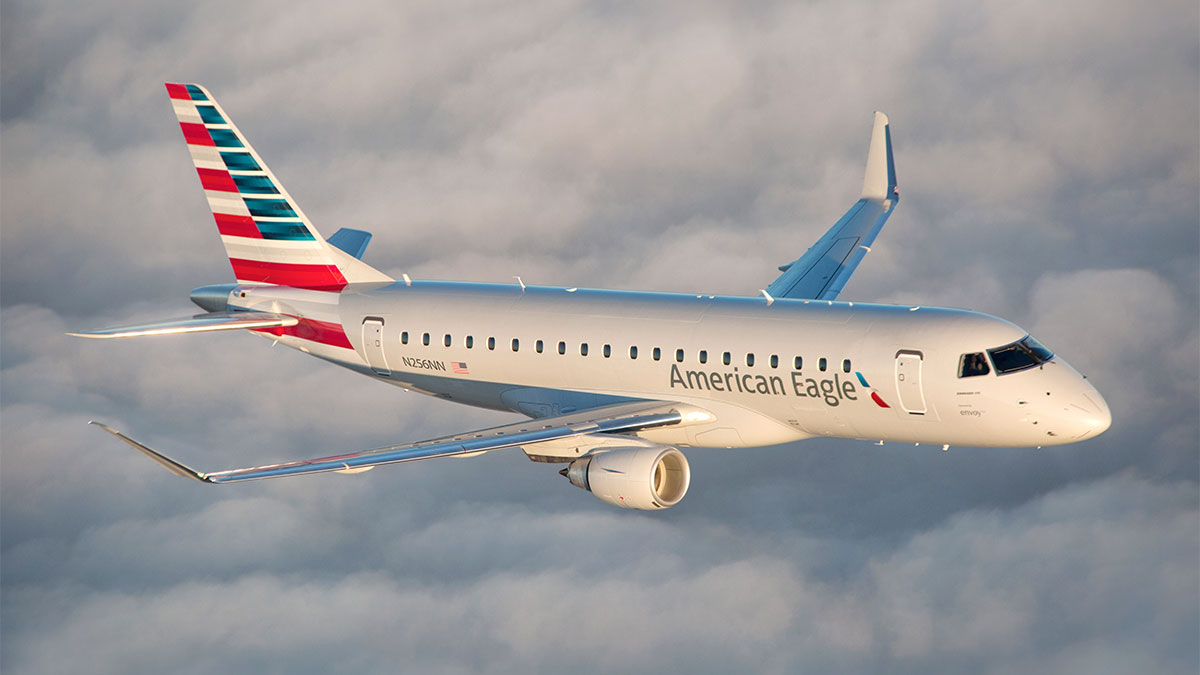

American Airlines flew the first U.S. commercial passenger flight last week using sustainable aviation fuel made without biobased feedstocks. The airline said the flight operated from Corpus Christi to Dallas-Fort Worth.
Fuel producer Infinium produced the electro sustainable aviation fuel, or eSAF, at its Pathfinder facility in Corpus Christi. The company makes the fuel using waste carbon dioxide and renewable electricity rather than plant- or animal-derived feedstocks.
Although American did not identify the aircraft used for the flight, Envoy Air typically operates Embraer E175s between Corpus Christi and DFW for American Eagle.
Fuel Entered Existing Airport System
Infinium blended the eSAF with conventional jet fuel before delivering it to the common fuel tanks at Corpus Christi International Airport. The fuel was then allocated to the American flight to Dallas-Fort Worth. American said the process demonstrated that eSAF can move through existing aviation fuel infrastructure.
“This flight represents a significant moment for aviation,” American Airlines CEO Robert Isom said in a company statement. “Through our partnership with Infinium, we’re demonstrating how next generation technologies like eSAF can move from early investment to real-world application.”
Larger Production Project Planned
Infinium says its Pathfinder facility has produced eFuels since 2023. American has also agreed to purchase commercial volumes of eSAF from Infinium’s planned Project Roadrunner facility in West Texas.
Infinium expects Project Roadrunner to begin producing and delivering eSAF in 2027. The company says the facility will produce more than 5 million gallons annually once it reaches full capacity.


Story is misleading. What is waste carbon dioxide? And how much of the CO2 derivative was blended with conventional jet fuel? Was the ratio 90 - 10 jet fuel to whatever it is? Clickbait
I agree. What is the ratio? What is the source of the CO2? Also, what is the real cost? Given enough energy, you can make about anything.
Just curious, does using SAF require a STC for that aircraft and if not would anyone know why? None of the turbine powered airplanes I have flown have SAF listed in the POH as approved jet fuel.
According to AI overview;
E-SAF (e-aviation synthetic fuel or power-to-liquid SAF) is significantly more expensive than traditional fossil jet fuel. While conventional fossil jet fuel typically trades around $2 to $2.50 per gallon (roughly $600 to $734 per tonne), e-SAF production costs range anywhere from $7 to $16+ per gallon (or roughly €7,695 / ~$7,500+ per tonne). This makes e-SAF roughly 4 to 13 times more expensive than conventional fossil fuels depending on regional pricing and calculation metrics.