















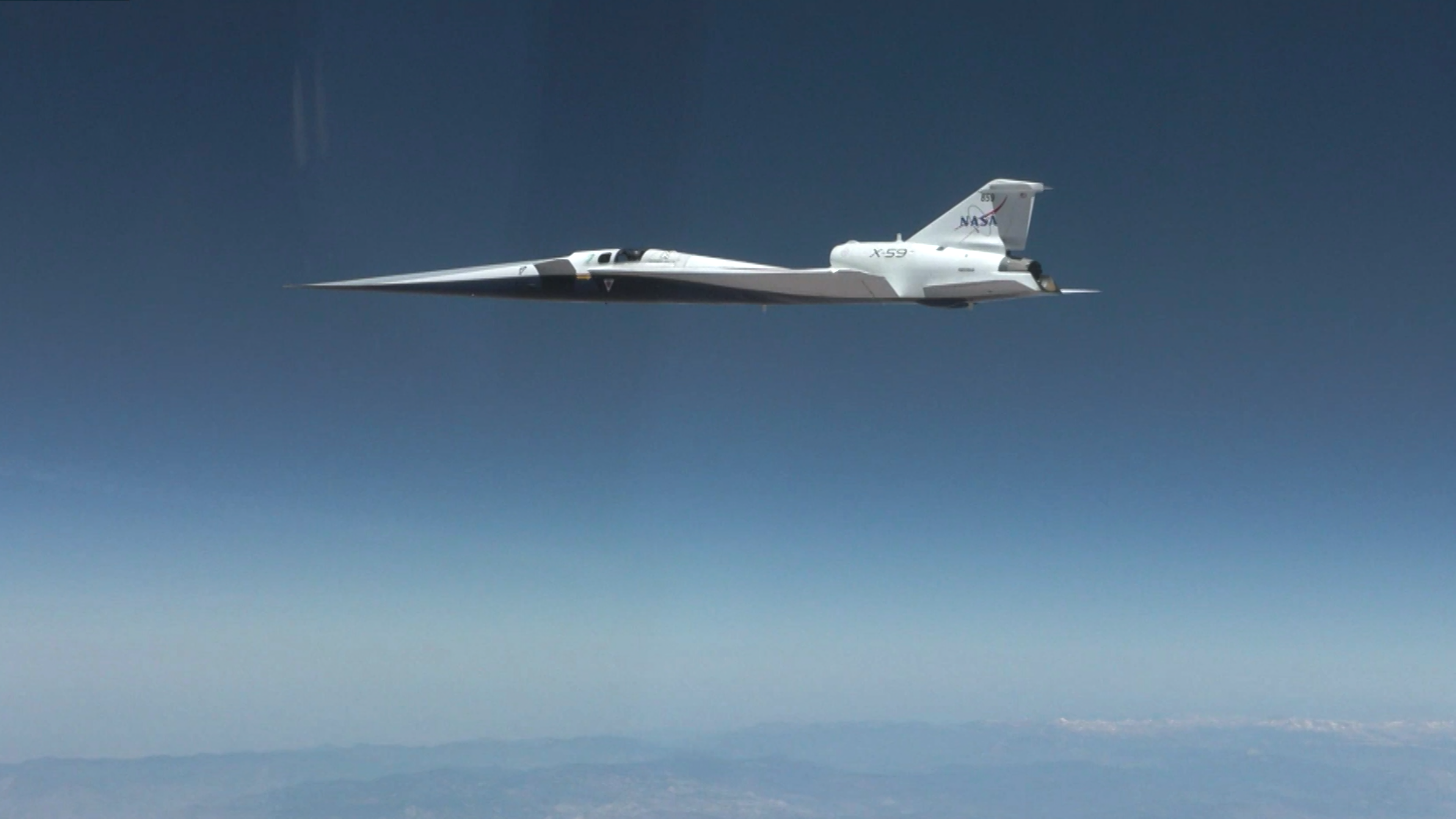

NASA X-59 Makes First Supersonic Flight

The quiet supersonic aircraft reached Mach 1.1 over California.

NASA X-59 Makes First Supersonic Flight
[Credit: NASA]
Gemini Sparkle

Key Takeaways:

  • NASA's X-59 quiet supersonic research aircraft successfully completed its first supersonic flight, reaching approximately Mach 1.1.
  • The initial test flight focused on evaluating the aircraft's handling qualities at both subsonic and supersonic speeds.
  • The X-59's quiet sound signature was not assessed during this flight due to sonic booms from an accompanying F-15 chase plane.
  • Future flights aim to reach Mach 1.4 and conduct community overflights to collect public response data on its reduced sonic signature for the Quesst mission, which seeks to inform new noise standards for supersonic flight over land.
See a mistake? Contact us.

NASA’s X-59 quiet supersonic research aircraft flew faster than the speed of sound for the first time on Friday, reaching approximately Mach 1.1 during an 81-minute test flight from Edwards Air Force Base in California.

NASA test pilot Jim “Clue” Less flew the aircraft to an altitude of 43,400 feet during the flight, which began at 11:08 a.m. PDT, according to NASA.

The agency said the flight was focused on evaluating the aircraft’s handling qualities at subsonic and supersonic speeds. An F-15 chase plane accompanied the X-59 during the flight, although NASA said the F-15’s sonic booms prevented crews from evaluating the X-59’s sound signature during the test.

“X-59 is getting ready for its quiet supersonic debut,” NASA Administrator Jared Isaacman said. “Since the aircraft’s first flight on Oct. 28, 2025, the team has made tremendous progress, flying 16 times in the last 90 days and getting into a steady test rhythm. In the coming days, we expect to take the next step and push to Mach 1.4.”

NASA said the upcoming flight is expected to take the aircraft to about 55,000 feet at Mach 1.4, the conditions planned for future community overflights under the agency’s Quesst mission. The program is intended to collect public response data on the aircraft’s reduced sonic signature for consideration by U.S. and international regulators as they evaluate future noise standards for supersonic flight over land.


Matt Ryan

Matt is AVweb's lead editor. His eyes have been turned to the sky for as long as he can remember. Now a fixed-wing pilot, instructor and aviation writer, Matt also leads and teaches a high school aviation program in the Dallas area. Beyond his lifelong obsession with aviation, Matt loves to travel and has lived in Greece, Czechia and Germany for studies and for work.
Sign-up for newsletters & special offers!

Get the latest stories & special offers delivered directly to your inbox

SUBSCRIBE

Please support AVweb.

It looks like you’re using an ad blocker. Ads keep AVweb free and fund our reporting.
Please whitelist AVweb or continue with ads enabled.