















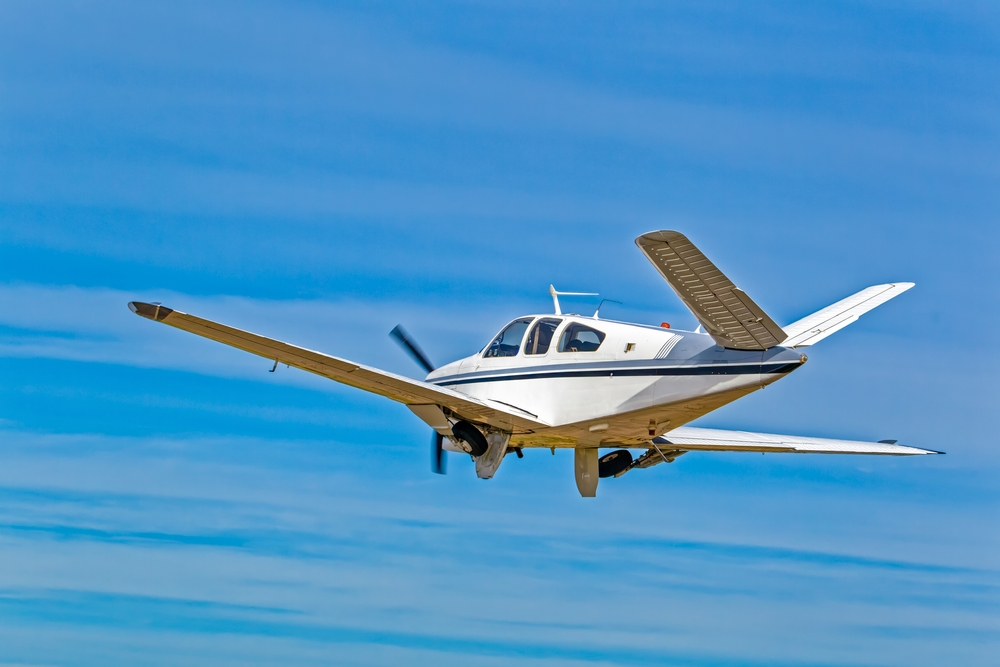

The American Bonanza Society Air Safety Foundation launched its Put Your Gear Down campaign this month to reduce landing gear mishaps involving Beechcraft Bonanzas, Debonairs, Barons and Travel Airs. The owners group says a Beechcraft retractable experiences some type of gear mishap nearly every week, and rising repair costs mean more damaged airplanes are being written off.
Preserving the Fleet
“Gear-related accidents are the greatest single threat to the longevity of the ABS fleet,” foundation Executive Director Thomas P. Turner said. “The board resolved that a Put Your Gear Down campaign, if successful, may be the most important thing ABS Air Safety Foundation ever does to extend the life of Beech Bonanzas, Debonairs, Barons and Travel Airs.”
Turner said the campaign followed the foundation’s 2025 Manuel Maciel Prize, which awarded more than $500,000 to the first company to certify replacement ruddervator skins for V-tail Bonanzas. He has tracked Beechcraft accident trends for more than 35 years and said other piston retractables experience similar gear-mishap rates after fleet size is considered.
Pilot Habits and Maintenance
The campaign urges pilots to make gear-position checks part of every approach, confirm the gear is down and locked before landing and avoid moving flap or gear controls during the landing roll. It also emphasizes proper inspection, maintenance and rigging because mechanical collapses account for many events.
“We want to see an increased emphasis on landing gear operating discipline and, importantly, improved landing gear inspection and maintenance,” Turner said.
The foundation plans to track pilots who take the campaign pledge and compare future accident and insurance-claim trends. Turner said several other aircraft owners groups have expressed interest in joining the effort.
Pilots can send the pledge and related training certificates to their insurance agent to document their participation. The campaign does not promise an insurance discount, although organizers hope fewer claims will eventually improve rates and availability.


The only retractable aircraft I’ve ever flown was the 182RG. And if one was dumb enough to even attempt to land one with the gear up, a warning blaring blast would come through the headsets. Doesn’t the bonanza do the same? The 182RG would do it when the manifold pressure dropped off, on an approach to landing, and the gear was still up.
Karrpilot-
Bonanza aircraft have the same type of gear warning horn. The problem occurs in many cases due to pilot distractions that disrupt the landing routine of gear down to go down.
The problem is one of my pet-peeves as a CFI: Pilots flying their planes on a real shallow approach hanging from the prop with lots of power applied. If more pilots practiced using a stabilized approach at idle or even close to idle, this wouldn’t happen because the landing gear alarm would be blaring all the way from base to final turn to landing if the gear isn’t down.
The excuse sometimes is short runways but that’s just lack of training. I fly my T-34A onto my 2500’ grass runway and since day one have been stopped and turning around in less than 1300’, and I bring it in smoothly and comfortably at 1.3 Vso.
Having about 5,000 hour flying Barons and Bonanzas I jst can’t figure out how you can land on with the gear up. These a very clean airframes and you need the gear extension so slow them down to the appropriate speed over the fence. Of course you have to be a pilot that flies air speeds. For an A35 or 55E Baron the settings are 3 degrees up trip, approach flaps, 2500 RPM and 15 inch manafold pressure and you will fly a 3 degree slide slope.
Years ago my son got his license at two diffferent airports ( had a scholarship). First taught him to come in higher, then drop to the runway, having additional altitude over the approach in case of issues. He can grease a crop-duster landing. Second was a low-and-slow approach type, and his first landing with that guy had him ready to bail out! To this day he can drop right onto a short runway with ease. He always said “altitude is my friend”, one to have but hope you never needed in a clutch.
Need Don Bateman’s GPWS?
‘Too Low Gear’
Yes, stable approach, ‘fly the numbers’.
Which should help cope with surprises like gusts.
I read herein that some pilots of single engine airplanes stay high in case engine quits just before runway.
First, data needs to be retrieved. Are these the “I only fly once every 6 months in blue skies” people? Or are they seasoned airline pilots flying 15 hours a month in their Bonanza? Bad training and ZERO annual training leads to shiddy pilots. Yes, it CAN happen to anyone but much less likely to happen to pilots who fly regularly. As for the gear up while on the ground why has no one come up with a WOW lockout 337? Poor engineering or money saving “ethics” created a plane that you can actually put the gear up while on the ground AND put it right next to the flap handle ??!! Finally, move or make repeater gear lights and place it UP IN FRONT OF THE PILOT rather than hidden low behind the yoke. READ AND DO the checklist. Thats why it’s REQUIRED by the FAA. No one has ever landed gear up after doing the checklist diligently. Confirming the gear is down on EVERY plane you fly builds a great habit when you move into a retractable airplane. “Gear down and welded” was my reply back in the Cessna 172 days. To not train that way means you don’t understand the law of primacy.
While many pilots do that, it’s not what the FAA wants taught. That ends up with an unstable final and that is pretty well established as the main factor causing landing accidents, which are the #1 accident on the FAA’s hit list. OTOH, how many cases can you find where a single engine airplane lost its engine in the landing pattern?
Considering the FAA’s definition of a stabilized approach (a constant angle glidepath towards a predetermined point on the landing runway at a constant airspeed and configuration), how do you fly a stabilized approach at idle?
Simple. You stay at pattern altitude until you’ve turned from base to final, then you go to idle and maintain “a constant angle glidepath towards a predetermined point on the landing runway at a constant airspeed and configuration” and just flare when you’re supposed to over the runway. Been doing it like that for almost 5 decades and it works every time.
I flew charter and night cargo for 2 1/2 years in a light twin before the airlines, mostly single pilot, and used the GUMP check. That never failed me. I would bet most of these gear up landings are caused by not observing some sort of sterile cockpit rule below 2000 ft, or at least in the pattern. YMMV.
Yes, I noted a supposedly common notion.
Yes, checklist use is SOP for pros.
(The B737-200 even had a line partway across the checklist on centre of control wheel, pilots could say ‘complete above the line’.)
I think this situation goes back to Bonanzas, Barons, Travelairs, and Twin Bonanzas built prior to the 1980’s that had the throw-over control column and the “piano keys” switches for gear and flaps and other functions. With the switches looking almost identical and the positions different from Piper or Cessna retracts, it is easy to reach for the gear switch on the ground thinking you are bringing up the flaps. I flew skydivers for 3 years in a Twin Bonanza and had to be careful even though the gear switch had a safety that had to be moved before bringing the gear switch to the up position. Modern larger planes and jets use big handles for gear positioning and put the flap handle on the throttle pedestal to avoid grabbing the wrong handle. Of course better checklist compliance would help also.
I agree - a stabilized approach - and using checklists should prevent virtually all of these incidents - not only in the Bonanza.