














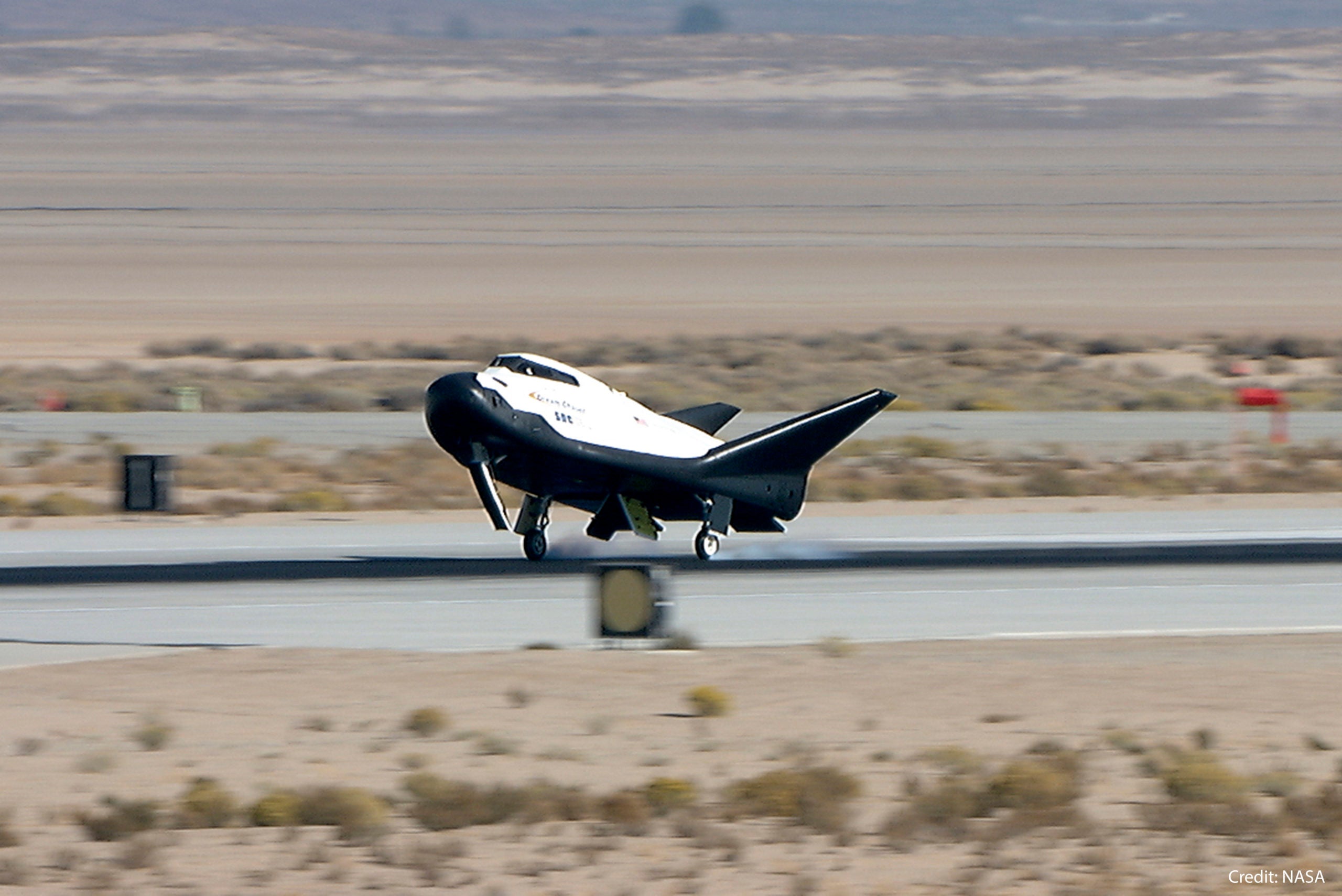

Citing delays related to the coronavirus (COVID-19) pandemic, Sierra Nevada Corporation (SNC) has pushed back the time frame for the first mission using its Dream Chaser spaceplane. Formerly scheduled for late 2021, the company now expects the Dream Chaser to make its initial flight to the International Space Station (ISS) in 2022. The cargo mission will be the first of a minimum of six conducted under a Commercial Resupply Services 2 (CRS-2) contract with NASA.
Although it was originally designed as a crewed vehicle, the first Dream Chaser mission will be conducted using the uncrewed cargo version. When paired with SNC’s disposable Shooting Star transfer vehicle, the Dream Chaser cargo system can carry up to 5,500 kg (12,125 pounds) to low-Earth orbit (LEO). Dream Chaser is a reusable lifting-body spacecraft with features including autonomous launch, flight and landing capabilities, folding wings, 1.5 G atmospheric entry and commercial runway landing compatibility. SNC also intends to provide disposal services using the Shooting Star, which is designed to burn up in the Earth’s atmosphere.
