











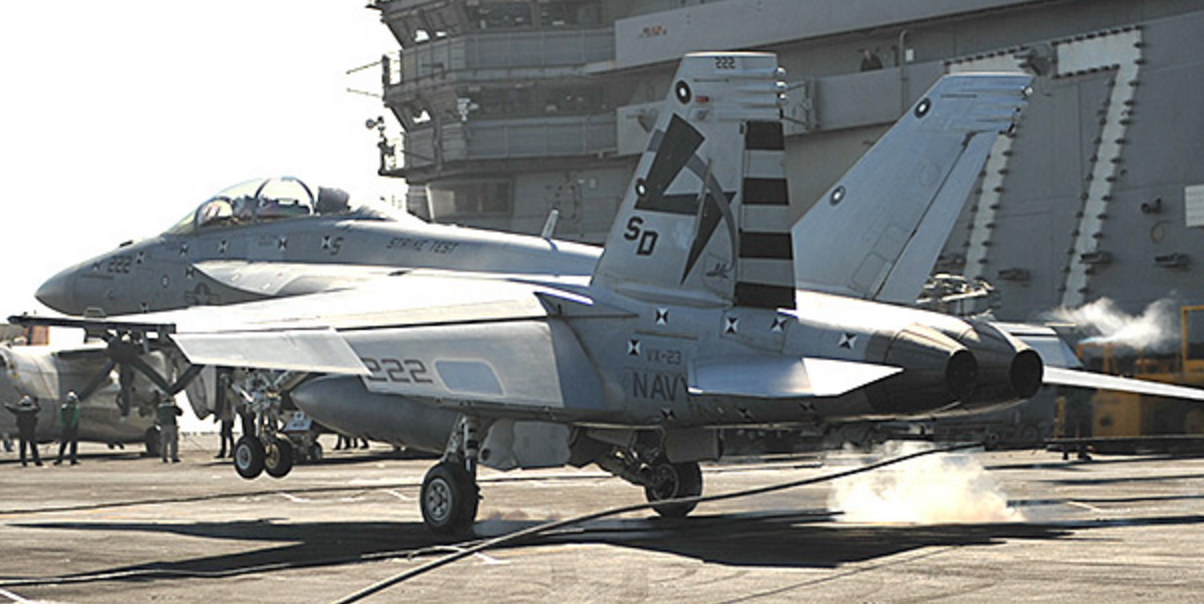
New software now ready for deployment is making it easier for pilots to stick the notoriously difficult aircraft-carrier arrested landing, the U.S. Navy said recently. The Navy worked with Boeing in June to test the new technology in sea trials aboard the USS George H.W. Bush aircraft carrier. Dubbed Magic Carpet — short for Maritime Augmented Guidance with Integrated Controls for Carrier Approach and Recovery Precision Enabling Technologies — the flight-control software helps to keep the jet on the correct glide path, with little effort from the pilot, to ensure a safe landing. The new technology will be deployed to the Navy’s fleet of F/A-18E/F Super Hornets and EA-18G Growlers in 2018.
The system requires only a software upgrade to the airplane, and nothing needs to change on the aircraft carrier itself. When Magic Carpet is engaged and put into “delta path mode,” according to USNI News, the jet will fly a 3-degree glideslope toward the landing site, regardless of wind and other conditions. Even when the jet flies through the turbulent air generated by the aircraft carrier’s wake, it automatically compensates and continues on its planned glideslope. “I’ve never seen anything like this before,” said Capt. David Kindley, program manager for the F/A-18 and EA-18G. If a pilot is coming in high, “you just push the stick forward and then let go, and it stops itself on glideslope. Same thing when I’m below glideslope, you just pull the stick back and then let go. So instead of making multiple corrections with the throttle and stick to affect glideslope, I’ve made one and then let go.”