
















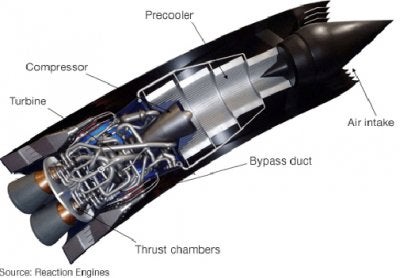
British inventor Alan Bond will reportedly receive more than $90 million from the British government to further develop technology for a hybrid jet-rocket engine that he expects will be capable of more than 3,500 mph in flight. Bond runs Reaction Engines, which seeks to develop a reusable space plane dubbed Skylon. The vehicle’s performance hinges on its synergistic air-breathing rocket engine (SABRE) and new highly efficient and lightweight heat exchanger technology. At speeds near Mach 5, Bond says the SABRE engine would see intake air temperatures near 1000 degrees Celsius. According to Reaction Engines, testing has shown that the engine’s recently tested heat exchanger is capable of cooling air by more than 1,000 degrees Celsius in less than the 1/100th of a second that it takes to pass through the engine — and without producing frost. The cooling is essential for the engine’s operation.
The SABRE’s heat exchanger uses tiny helium-filled tubes made from a nickel alloy called Inconel. The tubes’ manufacturer, Fine Tubes, produced more than 2000 km of highly specialized tubing for the SABRE engine and Skylon aircraft project. According to the company, the heat exchangers produced from its tubing are 100 times lighter than conventional technologies allow. Reaction says tests have now shown the heat exchanger system is up to the task of the near-instant frost-free cooling of intake air that will be essential for operation of the SABRE engine. Unlike conventional engines, SABRE switches in flight from an air-breathing engine to a rocket capable of speeds beyond Mach 5. Bond believes the technology will allow for huge reductions in cost for reaching low-orbit and orbital flight.

