















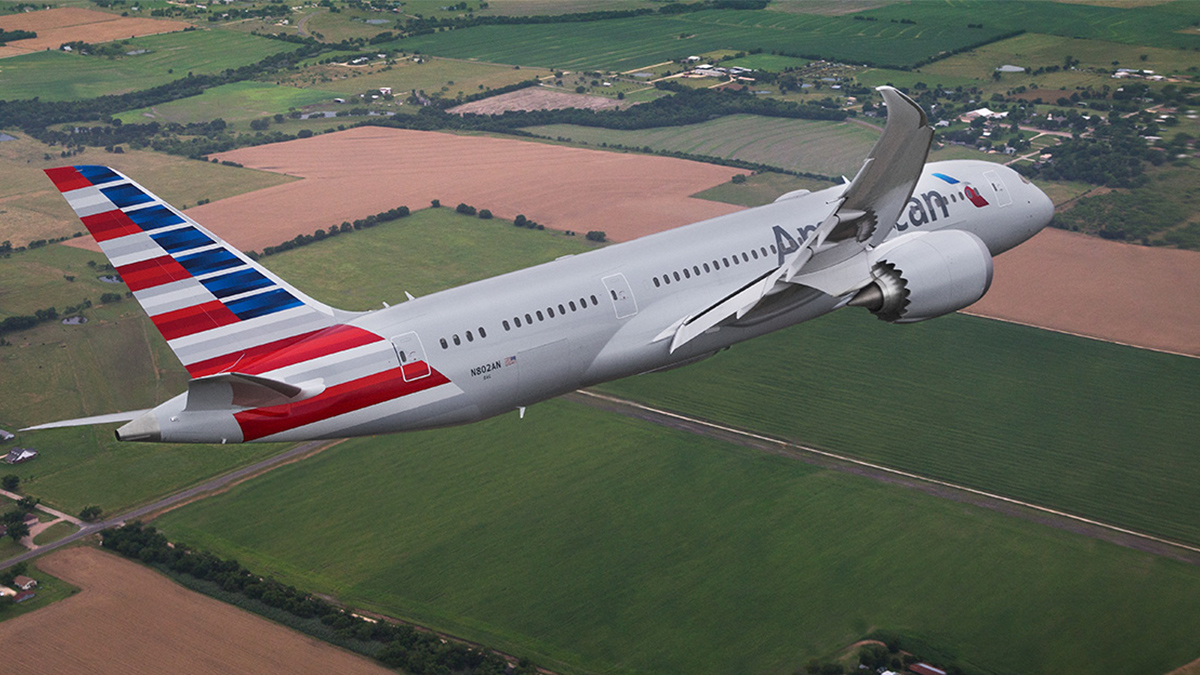

American Airlines and Google announced a sustainable aviation fuel certificate agreement on Tuessday that the companies say will support 35 million gallons of SAF over the next three years.
The fuel will be purchased by American Airlines and delivered to Chicago O’Hare International Airport through existing infrastructure. According to American, the SAF portion will be produced from waste feedstocks, including used cooking oil.
Google will receive the environmental benefits through the SAFc Registry to address emissions from employee business travel. The companies said the agreement is expected to account for nearly 300,000 metric tons of carbon dioxide equivalent emissions reductions and enabled American to reach a long-term SAF offtake agreement with Valero Marketing and Supply Company.
“Our industry-leading agreement with Google is a critical step forward in reducing emissions from our operations,” said Jill Blickstein, American Airlines’ chief sustainability officer. “By working with leaders like Google who share our commitment to innovation, we’re helping to grow demand for SAF and support the development of a stronger, more resilient market.”
The agreement comes as IATA Director General Willie Walsh said Sunday that the airline industry’s 2050 net-zero target may need to be reviewed as SAF production and access to carbon credits remain below current targets. According to IATA, SAF production is expected to reach 2.4 million tons this year, enough to cover 0.8% of airline fuel demand.


Sigh.
Gergle is pandering to apocalyptics.
Reality is that Accurate temperature measurements like weather balloons, satellite sensors, and tide gages show only slow warming since the end of the cool era that drove Viking farmers out of southwest Greenland. (The Medieval Warm Period was warmer than today, its climate was stable.)
The ‘saturation effect’ of overlap of spectra of carbon dioxide and dihydrogen monoxide limits rise to a small amount most of which has already been realized. (Changes in water vapour show there is not a positive feedback mechanism.) The effect of CO2 is asymptotic - decreasing effect to a limit.
Climate varies, extremes are rare. Overall variation of is primarily the result of change in earth’s distance from the sun as the gravitational effect of large planets affects earth’s orbit - length of orbit varies among planets, sometimes effect on earth cancels out but other times it adds up. (Same with weather extremes, as research meteorologist Cliff Mass explained about the heat of June 2021 and the rains of November 2021 in the PNW/PSW region.)
Lol. I couldn’t help but roll my eyes at the shortsightedness of the first comment.
Concur. Keith has a habit of providing well-though-out information that doesn’t relate to the topic. The article isn’t about climate change.
to ’ Chuck KubinChuck-the-Wise who isn’t wise enough to read and think:
Then why the work on ‘SAF’ fuels?
Read ‘emissions’, read ‘sustainable’, …
To ’ RtrdCtrl’
the purpose is to mitigate effect on climate of fossil fuels, Google is in effect buying carbon credits.
Read!
What a joke! “Carbon credits” is nothing more than a shell game con that does nothing to actually reduce one’s “carbon” footprint. Just another way to tax something without calling it a “tax”.
Wow Keith. That’s about all I can say. While some of your assumptions may be correct, I would say that the recent studies, (last 40 years or so) have given us a much clearer look at man made pollution, beginning around the time of the Industrial Revolution.
I agree with others. This is just buying carbon credits by google, rather than reducing their own carbon footprint. As you probably know,the credit system first started in Europe. It has some merits as far as reducing overall carbon, but, it also allows the more prosperous and/or heavier polluters to just buy their way out, for now. They show off to their investors how much they care for the environment, and boast about how much they have spent being”responsible corporate leaders” when in actual fact, they haven’t done anything but buy their way out. For now. No look ahead to the future.
Aviation has been one of the leading industries to reduce carbon for many years. Don’t laugh,just think about it. New technology engines,wings structures, winglets, geared fans,supercritical wings; need I go on?
Yet nobody has given us any of the credit. Weinaviation have footed the bill for all of this. Look how fuel efficiency has increased with each iteration: winglets,around 5%. Carbon fibre compnents,who really knows,but a huge improvement. Higher effiency engines, 12 to 20%? Then there are the procedural things,like improved flight paths, major ATC traffic improvements,saving fuel during departures and arrivals, streamlined descents, you get the picture.
We weren’t always making these improvements to primarily reduce carbon emissions, but it was an additional benefit. Nobody talks about who covered the costs for all of this, but aviation companies,private, corporate,airline and general,all stepped up and spent their bucks. Ok. I’m done now.