
Flying squadron colors as a form of establishing camaraderie and teamwork is a tradition that goes back to “pursuit” (later called “fighter”) pilots of World War I, the first air war. The legacy picked right back up in World War II, with the added incentive of enabling fighter pilots to instantly identify squadron mates by the colors painted on the noses or tails of their planes at airspeeds in excess of 500 MPH.
Two members of the 336th Squadron of the red-nosed Fourth Fighter Group—themselves veterans of the British Royal Air Force 133 “Eagle” Squadron where they got their start in combat—took it a step further. Ohio native Don Gentile (pronounced “Gentilly”) and Rhode Island’s Johnny Godfrey formed an uncannily coordinated combat duo, seeming to sense each other’s moves before the next twist of the other’s throttle or control stick. Gentile and Godfrey had their ground crews paint broad red-and-white checkerboard patterns on the cowlings of both of their P-51 Mustangs, the better to catch the other’s eye in the heat of aerial combat.
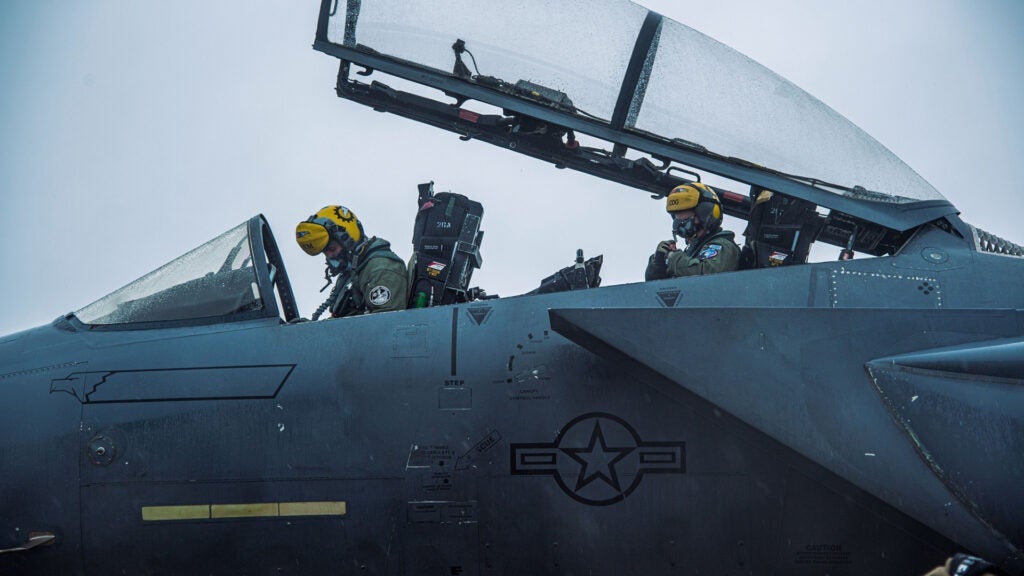
Today, members of the 336th Fighter Squadron of the North Carolina-based modern-day Fourth Fighter Wing are taking a page from their forbears—not exactly the same level of exotic nose art applied in World War II, perhaps—but first adding yellow slashes on the tails and fuselages of their F-15s—then donning yellow scarves, and now yellow helmets to distinguish them from their sister squadrons 333rd (red), 334th (blue) and 335th (green).
“Your color is who you are,” said retired USAF Colonel James Jinnette, originally assigned to the 336th, eventually advancing to become “Yellow” squadron’s operations officer. “That’s our identity,” he said. “We’re all trying to do the mission as best as we can, and part of that is the morale, esprit de corps, and history you’re attached to.”
In what has been a decades-long monochrome USAF world of gray helmets and gray aircraft launching into frequently gray skies, a splash of color here and there around the Fourth Wing’s Seymour Johnson Air Force Base brings back some of the sense of individualism that was tolerated in the young fighter pilots of World War II, but which also contributed to a spirit that enabled the Fourth to destroy more Luftwaffe aircraft (1,016) than any other group in the war.