















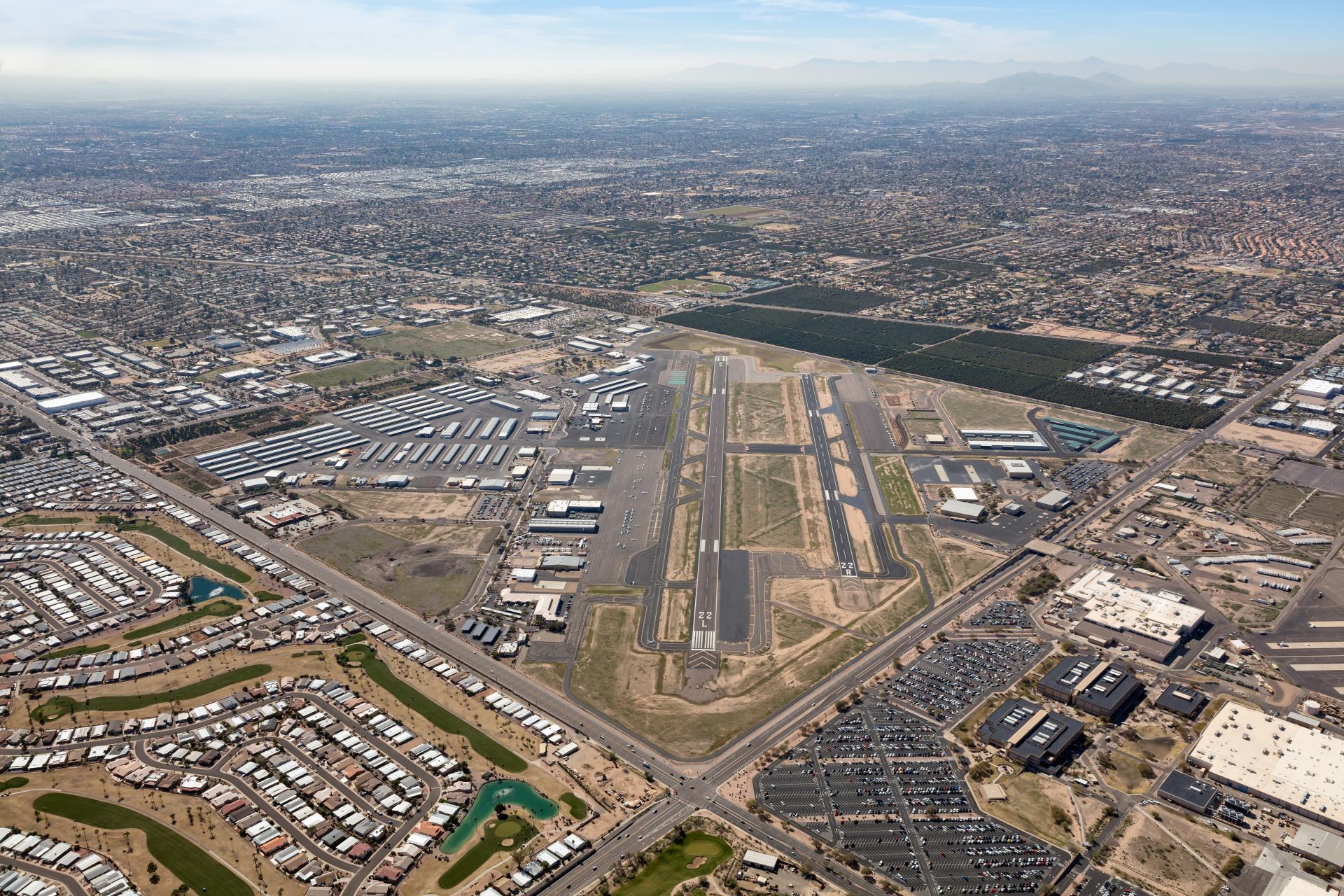

Mesa City Council on Monday unanimously approved a measure introducing landing fees and related charges for Arizona’s Falcon Field Airport. The new fees and related rate increases will take effect May 1.
City staff presented the change as a budget and maintenance issue. In a newly released fees and charges report, airport officials said Falcon Field has relied for years on revenue from a 2006 land sale and on deferred maintenance and capital work, and said those one-time funds are expected to be exhausted within one to two years. The report, along with a March 5 presentation deck, said inflation and rising capital costs have outpaced prior fee increases and left the airport behind on maintenance and repair.
Aviation users warn of higher training costs
Opposition to the landing fee plan had been building before the council vote. In a March 12 joint statement, flight schools, aircraft owners, instructors, mechanics and other airport businesses urged council members to reject the proposal, arguing that per-landing charges fall hardest on training flights because students make repeated takeoffs and landings in a single lesson. The statement said the landing fees could raise training prices, reduce repetitions, slow certification and affect the airport’s surrounding business network. It also raised concerns about how landings would be tracked, billed and enforced.
After the vote, Carl Storckman, owner of Legion Air Flight School, told FOX 10 Phoenix the landing fees would affect smaller operators. “These landing fees are really gonna harp on our ability to conduct business at Falcon Field,” Storckman said. He said the added cost would likely be passed on to customers and could increase the price of flight training.
City cites budget and maintenance needs
The city is tying the new landing fees at Falcon Field to the airfield cost center, which covers items such as runways, taxiways, lighting, safety areas, rescue firefighting services, the terminal building and the airport maintenance facility. Staff put FY 2025-26 airfield costs at $2,410,432 and projected $374,300 in revenue from existing airfield sources, leaving a projected $2,036,132 gap without landing fees. The city estimated the full fee package approved March 23 would generate $2,894,770 a year, including $2,637,744 from landing fees.
A Mesa resident who supported the change said the city had spent substantial time reviewing the issue.
“Falcon Field can’t continue as is without someone picking up the slack,” Kaye Hunsacker told FOX 10 Phoenix after the vote. “I’m glad they realize that those users need to do that.”
Fee structure and next steps
Under the structure described in the city report, based fixed-wing aircraft at or below 6,000 pounds maximum landing weight will pay $20.35 per landing at Falcon Field, while itinerant fixed-wing aircraft in that category will pay $24.35. Heavier fixed-wing aircraft will pay by weight, at $3.40 per 1,000 pounds for based aircraft and $4.10 per 1,000 pounds for itinerant aircraft. Based rotorcraft, drones and eVTOL aircraft will pay $12.60 per landing, and itinerant rotorcraft, drones and eVTOL aircraft will pay $17.60.
Based aircraft at Falcon Field will receive the first 10 landings each month without charge.
The city also included exemptions for emergency landings, government aircraft, certain rotorcraft training and testing operations, production flight testing by some based tenants, flights supporting government functions, and medical or animal rescue flights.
The March 23 report said the fee model also assumed a 10% drop in aircraft operations; if operations fall by 20% or more from year-earlier monthly totals for three straight months, the city manager or a designee may raise landing fees once within 18 months, subject to notice and the limits in the original public notice.
The March 5 airport presentation said the alternative to the fee changes would be either transferring city general fund money to cover essential airport projects or deferring additional work. The same presentation put ongoing pavement maintenance across airport areas at about $5.75 million a year over the next eight years, noting that FAA funding does not cover ongoing pavement maintenance such as crack fill and seal coat.
The city report said officials sought input from a stakeholder group that included recreational pilots, airport businesses, corporate aircraft owners, flight schools and area residents, and said Falcon Field held 15 virtual informational and consultation meetings with aeronautical users and tenants before the matter reached council. An earlier version of the proposal prior to those meetings would have allowed five free monthly landings for smaller based aircraft before higher charges applied.
The fee changes approved Monday are scheduled to take effect May 1.


I love watching the results of decisions made by stupid “smart” people. Incapable of understanding the most basic elements of cause and effect, they create the unintended consequences that they then say they alone have the solution to. Aviation in the USA is in increasing decline due to stupid smart people,
During flight planning, one of the first things that i do is look for those added fees. If i see them, and i don’t really have to go to said airports, i don’t. Reroute is in order. Same things with getting fuel. I check the prices. Flying is expensive enough.
if operations fall by 20% or more
So, they introduce fees, which cause a reduction in operations, so they raise the fees, which causes another reduction…
Eventually the one operation per month will fund the months bill.
And why don’t government operations pay?
Flight school operations based at a fee-based airport should have other breaks given than just “10 free operations a month.” Even if they go to other airports in the area for take-off and landing practice, that still is untenable, considering that student pilots will still be footing a very substantial increased bill for ridiculously high cost-per-hour that has already made the cost of flight training out of range for anybody not very well heeled.
If you can’t afford to support the system, sell your airplane. If a landing fee is going to break your bank, maybe you should take up radio controlled flying.
Now that I too am an airplane owner, I do the same thing.
I try to avoid landing fees just like I try to avoid toll roads. I pay taxes already with fuel purchases and other local taxes that are supposed to be used in aviation related purposes. Adding more and more costs just drives more and more pilots out of aviation altogether. And if you make initial training more expensive, that will just drive away those who otherwise would want to make flying a career. Then the alleged “pilot shortage” just might become real in this country.
I can afford to support the system. I choose not to pay for the vaulted ceilings, cappuccino machines, pilots lounges, full service gasoline, and others items that I’ve never used, and will not.