



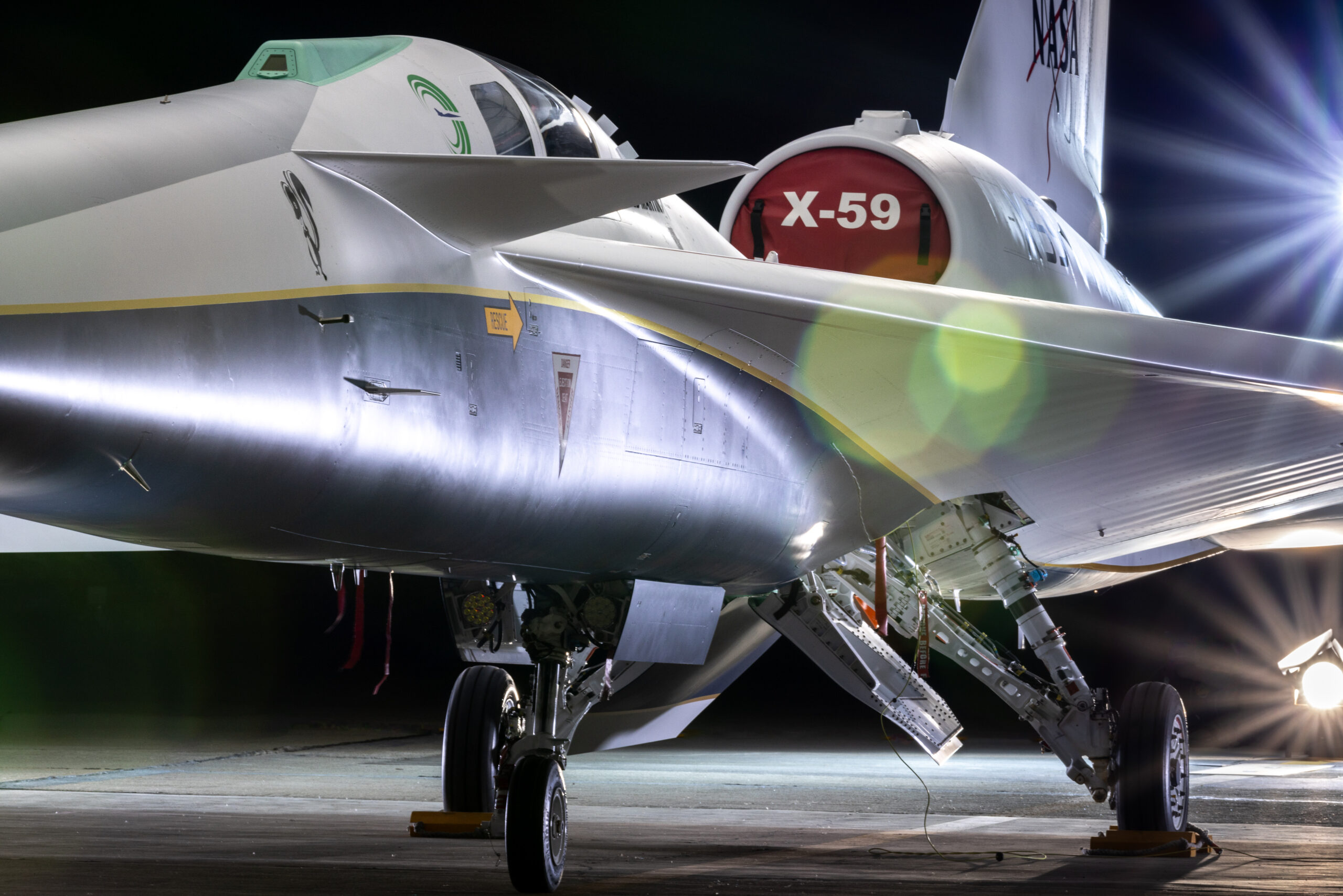

NASA’s X-59 quiet supersonic research aircraft conducted its first flight today from the U.S. Air Force’s Plant 42 in Palmdale, California. The flight is a major milestone in the agency’s Quesst mission to demonstrate low-boom supersonic flight. The Skunk Works–built jet took off at approximately 8:14 a.m. local time for a short shakedown flight reaching about 240 mph and an altitude near 12,000 feet before landing at NASA’s Armstrong Flight Research Center in Edwards. NASA test pilot Nils Larson evaluated basic handling qualities and system integration.
GO GO GO NASA X-59! First Flight!!!!! pic.twitter.com/Ykeq2FNZZr
— Matt Hartman (@ShorealoneFilms) October 28, 2025
The first flight begins a months-long series of envelope-expansion tests to confirm airworthiness and safety before the X-59 moves into higher-speed runs exceeding the speed of sound. Built by Lockheed Martin’s Skunk Works under NASA’s Quiet Supersonic Technology (QueSST) program, the NASA X-59 measures nearly 100 feet long with a sharply tapered nose designed to disperse shockwaves and reduce the sonic boom to a quieter “thump.”
NASA said data from future flights will be shared with U.S. and international regulators to help establish new acceptable noise thresholds for commercial supersonic operations over land. Several private companies are exploring the space with the aim of future commercial supersonic flight. One such company, Boom Supersonic, broke the sound barrier with its XB-1 for the first time in July. It was the first civil-designed aircraft to do so since the Concorde.
Developed in partnership with Lockheed Martin since 2016, the X-59 is powered by a single F414-GE-100 turbofan mounted above the fuselage to minimize shockwave merging beneath the aircraft. The aircraft’s cockpit sits far aft with no forward-facing window; rather, the pilot utilizes NASA’s eXternal Vision System, which uses cameras and a 4K monitor to provide a forward view. The aircraft also incorporates digital fly-by-wire controls and layered backup systems for safety.
The jet began taxi testing earlier this year in July.
Airborne! The @NASA X-59 QueSST is making its first flight. The aircraft is uniquely shaped to fly supersonically without making a loud sonic boom. https://t.co/PWWsFcLJsk pic.twitter.com/d6vJMI5Hta
— Flightradar24 (@flightradar24) October 28, 2025
According to NASA, today’s flight marks the first step toward proving that supersonic travel can be achieved safely and quietly while potentially paving the way for a new generation of commercial aircraft to fly faster than sound without the disruptive booms that once grounded them.


0 replies