














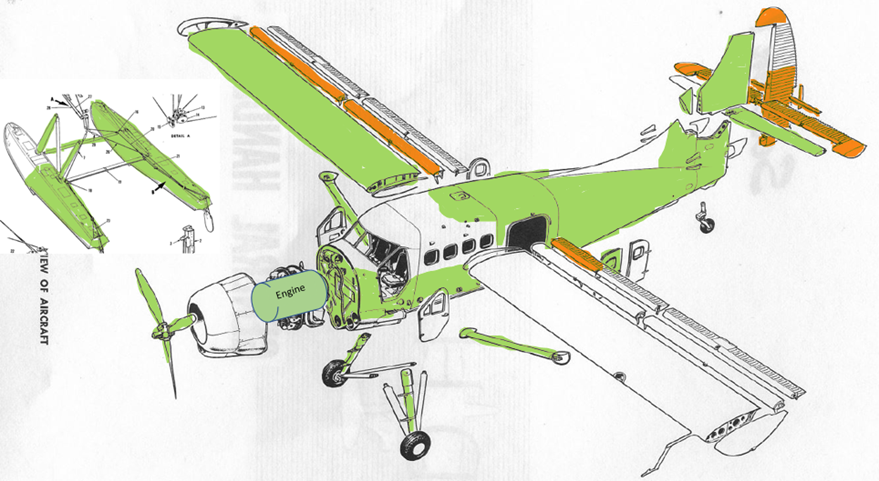

The National Transportation Safety Board (NTSB) announced on Monday that it has identified a possible safety issue with the flight controls of a De Havilland Canada DHC-3 Turbine Otter that crashed into Mutiny Bay, Washington, last month. According to investigators, the horizontal stabilizer actuator was “found separated where the clamp nut threads into the barrel section” with further examination suggesting that the “components separated by unthreading as opposed to being pulled apart in tension.” The circular wire lock ring used to prevent the pieces from unthreading has not been found in the wreckage.
“At this time, the NTSB does not know whether the lock ring was installed before the airplane impacted the water or why the lock ring was not present during the airplane examination,” the Board said in its investigative update. “The NTSB, in coordination with the Transportation Safety Board of Canada, has asked that the manufacturer draft instructions for an inspection of the actuator to ensure that the lock ring is in place and properly engaged to prevent unthreading of the clamp nut. Those instructions will be released and provided to all operators of the DHC-3 airplane worldwide in a Service Letter.”
The aircraft went down on Sept. 4, 2022, killing the pilot and all nine passengers onboard. The NTSB noted that approximately 85 percent of the airplane was recovered from the sea floor. The investigation is expected to continue with examinations of both elevators, interviews of the FAA principal operations and maintenance inspectors assigned to the operator, a review of maintenance records and interviews with maintenance personnel. The Board is also planning to conduct an evaluation of lock ring failure modes and lock ring installation instructions along with an aircraft performance study. As previously reported by AVweb, the FAA issued an emergency AD requiring immediate inspection of the left-hand elevator auxiliary spar on DHC-3 Otters on Oct. 4 due to the crash.
