














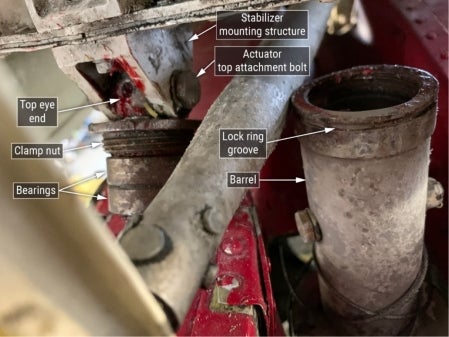

The National Transportation Safety Board (NTSB) has issued an urgent safety recommendation asking the FAA and Transport Canada to require all operators of De Havilland Canada DHC-3s to conduct an immediate one-time inspection of horizontal stabilizer actuator lock rings on the aircraft. The recommendation (PDF) follows the Board’s identification of a possible safety issue with the lock ring on a DHC-3 Turbine Otter that crashed in Mutiny Bay, Washington, on Sept. 4. The pilot and all nine passengers on board were killed in the accident.
“Immediate action needs to be taken to inspect the actuator of DHC-3 airplanes, of which 40% operate in the United States, to prevent a similar tragedy from happening,” said NTSB Chair Jennifer Homendy. “NTSB is issuing this urgent recommendation as a result of a significant finding made by NTSB investigators.”
According to the NTSB, examination of the accident aircraft found that “the clamp nut that attaches the top eye end and bearing assembly of the horizontal stabilizer actuator to the actuator barrel had unscrewed from the barrel.” The Board reported that the components appeared to have unthreaded rather than separating during the crash, noting that in the event of such a separation “the actuator would not be able to control the position of the horizontal stabilizer, resulting in a reduction or loss of pitch control.” The circular wire lock ring designed to prevent the clamp nut from unscrewing was not found in the wreckage, about 85 percent of which was recovered from the sea floor. The accident investigation is ongoing.

