














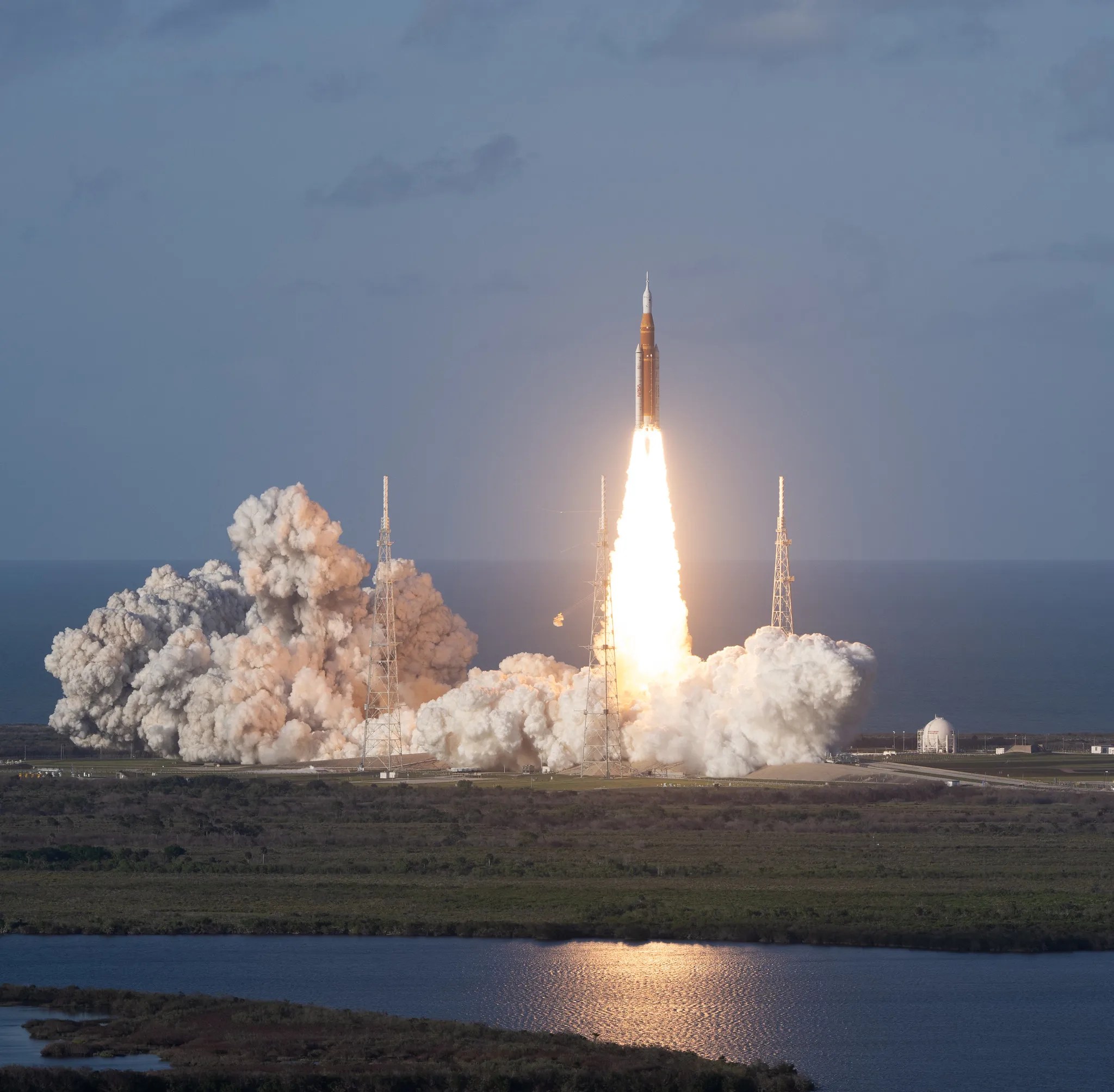

The Boeing-built Space Launch System (SLS) core stage successfully powered NASA’s Artemis II mission on Wednesday, propelling four astronauts on a historic 10-day journey around the Moon.
According to a Boeing news release, the rocket’s core stage functioned flawlessly during liftoff at 6:35 p.m. ET from Kennedy Space Center. It successfully separated from the crew capsule eight and a half minutes into the flight.
This separation allowed the Orion spacecraft—carrying NASA astronauts Reid Wiseman, Victor Glover, and Christina Koch, alongside Canadian Space Agency astronaut Jeremy Hansen—to continue its deep space trajectory.
John Shannon, vice president of Boeing’s Exploration Systems business, stated in the release that the vehicle is designed to withstand incredible atmospheric forces and “performed exactly as intended” while ensuring the safety of the crew.
SLS success
The SLS core stage built by Boeing serves as the structural backbone of the rocket and is the tallest stage contracted by NASA, towering at 212 feet.
Covered in distinctive orange insulating foam, the stage houses critical flight computers and avionics. It also stores the cryogenic liquid hydrogen and liquid oxygen needed to feed the rocket’s four RS-25 engines.
During the ascent, the core stage burns over 700,000 gallons of these propellants to produce a massive 8.8 million pounds of thrust, as detailed on Boeing’s Artemis II mission page. This power enabled the rocket to reach an altitude of 530,000 feet before the stage completed its mission and was jettisoned.
The core stage successfully executed several complex operations during Wednesday’s launch, from pre-launch fueling to in-flight thrust vector control.

And NASA paid more for one of the four main engines than it does for an entire Falcon Heavy launch. Boeing to the rescue!
I helped build the Saturn V’s F1 main engines at Rocketdyne division of North American aviation 60 years ago. I can appreciate the complexity of what it takes to build a launch system this complicated.
There are thousands of people involved to make this work as designed.
Everyone sees the talking heads on TV but those who do the real Work are just as important in the final product.
I congratulate Everyone who made this a sucess.
Hey, at least it didn’t explode!