
















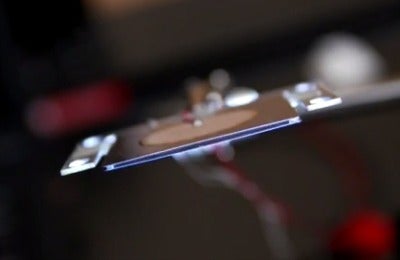
Tiny devices called synthetic jet actuators could be placed along the leading edge of a wing and create small puffs of air that virtually change the shape of the wing, reducing drag, according to scientists at GE Global Research. The scientists are developing the technology not only for use on airplanes but also on wind turbine blades. “The device is lightweight and very simple in operation, with minimal power usage,” said Seyed Saddoughi, principal engineer, who is leading the project. “By expanding and contracting a chamber such that air is sucked in and ejected through a single hole, this device works similar to a human lung. The advantage is that there is no need for pumps that use external flow, or fans with moving parts.”
The devices pump air efficiently by applying an alternating current to two parallel plates separated by a slight space, according to GE. The two plates bend and straighten as electricity moves through them, causing the middle chamber to rapidly pull in and push out air. The technology is already in development for use as a cooling device in consumer electronics and computers, GE said. But Saddoughi says the technology’s true potential will be realized by embedding rows of them in the wings of jets and turbine blades. More details about the technology are posted at GE’s Txchnologist website.

