
















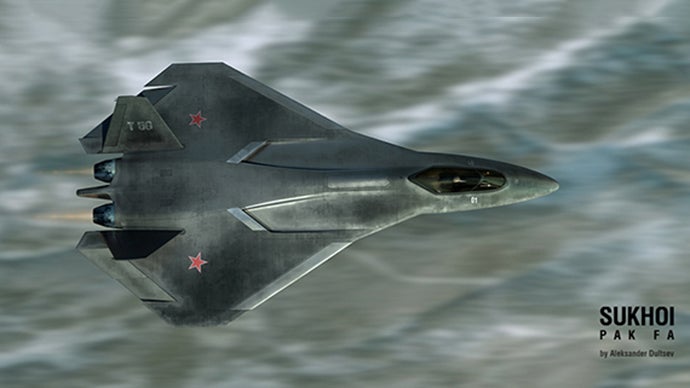
photo credit: www.duler.ru
Loosely based on comments made by the former commander-in-chief of the Russian air force, Army General Pyotr Deynekin, rumors have emerged that Russia’s next long-range assault jet will likely be unmanned, but it’s not coming very soon. The General said that a sixth-generation program is in the works and told RIA news agency it “most probably” will be unmanned. Currently, the Russian military is awaiting its fifth-generation heavy attack jet, the PAK-FA, which is not expected to enter service before 2016. Russia hopes that jet will be virtually undetectable by enemy radar and extremely maneuverable if engaged in a traditional dogfight. The laundry list of capabilities that loosely defines a sixth-generation fighter jet is long and out of the range of current technology and Russian test pilot Sergey Bodgan does not expect to see one within the next decade.
Early in August, Bodgan publicly said that a new-generation fighter might not evolve for another 15 years, for now, leaving pilots as essential components of the system. But a sixth-generation fighter may be more capable without a biological entity onboard. Some U.S. experts define a sixth-generation jet as one with extreme stealth, capable not only of flying at subsonic speeds but also up to 5 Mach while retaining the ability to engage and destroy targets. Structural developments may include next-generation materials capable of changing shape in flight with some self-healing capability. The aircraft are expected to employ a vast array of sensors and networking capabilities, allowing them to function as a larger network of information gathering and weapons delivery. If Russia is on pace for a roughly 2028 introduction of a sixth-generation military jet, that puts it on pace with U.S. estimates for its next generation tactical aircraft, currently expected before 2030.

