



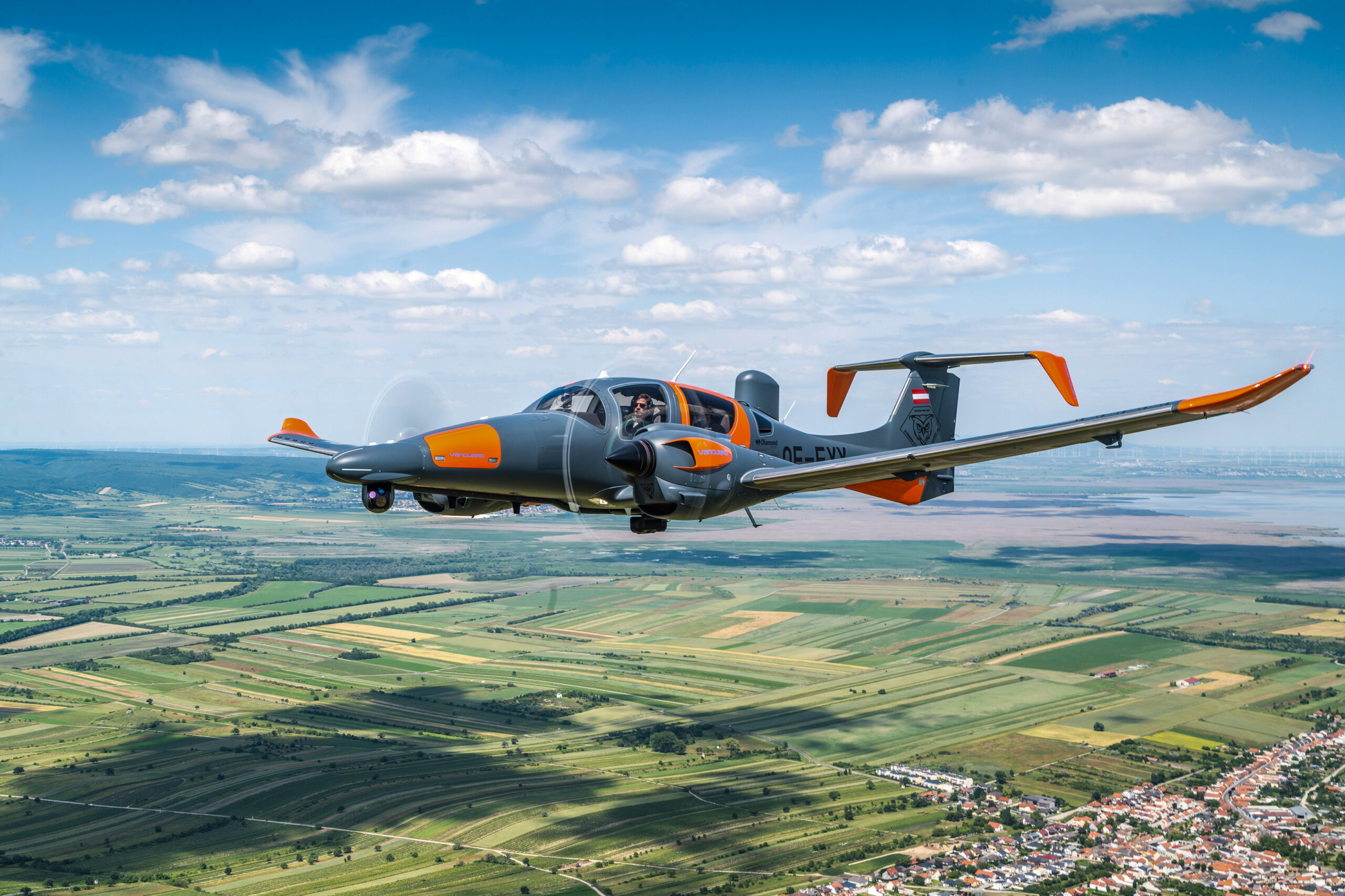

Diamond Aircraft on Thursday released information on a series of updates to its DA62 MPP special mission aircraft completed in 2025, along with additional upcoming developments planned for 2026. The recent work centered on connectivity, certification and avionics integration aimed at expanding the aircraft’s use across intelligence, surveillance and reconnaissance, environmental monitoring and maritime operations.
The DA62 MPP is based on Diamond’s DA62 twin-engine platform, which entered service in the mid-2010s as part of the company’s line of composite aircraft. The multi-purpose platform variant was later developed to support specialized missions through the integration of sensors, data links and mission systems.
As part of that effort, the company conducted a six-month series of Starlink Mini flight trials across Europe and parts of North Africa, testing the use of high-bandwidth connectivity for real-time communications and sensor data transmission.
Updates also included an increase in maximum takeoff mass from 2,300 kg to 2,360 kg. Diamond completed certification for flight into known icing (FIKI) for certain mission configurations, enabling operations in a wider range of weather conditions.
The aircraft additionally received certification for an integrated diversity transponder, which Diamond said will improve tracking and communication with both ground-based and satellite ADS-B systems, particularly in remote areas or during low-altitude operations.
Diamond said its 2026 plans for the platform will focus on further integration of mission systems and aerodynamic refinements. It said it plans to include a redesigned radome intended to reduce drag and support beyond-line-of-sight operations, as well as a tail-mounted camera integrated into the Garmin G1000 display to provide additional situational awareness.
The company also said it is working toward certification for non-eye-safe laser installations and on introducing a modular mounting structure designed to accommodate different payloads, including LiDAR systems and search-and-rescue equipment. Such installations would allow the use of higher-power laser systems for applications like advanced mapping or target designation, while requiring additional safeguards due to potential risks to eyesight. A new radar pod is also in development to support surveillance missions.


0 replies