














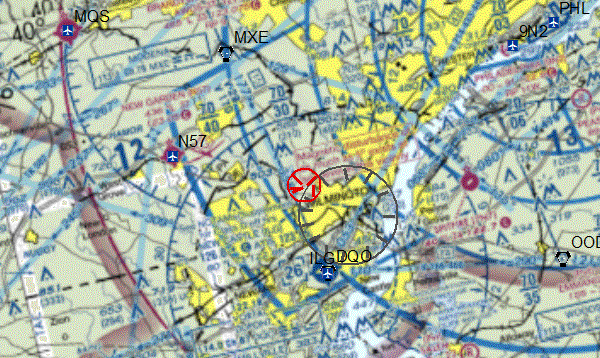

With vote counting ongoing in the U.S. election, the FAA has extended a temporary flight restriction (TFR) over Democratic presidential candidate Joe Biden’s residence in Wilmington, Delaware, through Nov. 11. The TFR was initially put in place over the area for “special security reasons” on Nov. 4 with an end date of Nov 7. The Nov. 4 NOTAM defining the TFR also designated the location as national defense airspace.
The current TFR over the former Vice President’s residence covers a 1 NM radius up to 1000 feet AGL. A second, adjacent TFR was put in place on Friday for VIP movement. The VIP TFR has a 3 NM radius and extends up to 2999 feet AGL. It is valid through Nov. 7 and the area covered was also defined as national defense airspace.
Both active TFR NOTAMs include an exception for aircraft arriving or departing from Wilmington’s New Castle Airport (KILG), noting that aircraft approved to operate in the area must squawk a discrete transponder code and maintain two-way radio communications with air traffic control. The NOTAMs further warn unmanned aircraft systems (UAS/drone) operators that “the Department of Defense (DOD), the Department of Homeland Security (DHS) or the Department of Justice (DOJ) may take security action that results in the interference, disruption, seizure, damaging, or destruction of unmanned aircraft deemed to pose a credible safety or security threat to protected personnel, facilities, or assets.”
