














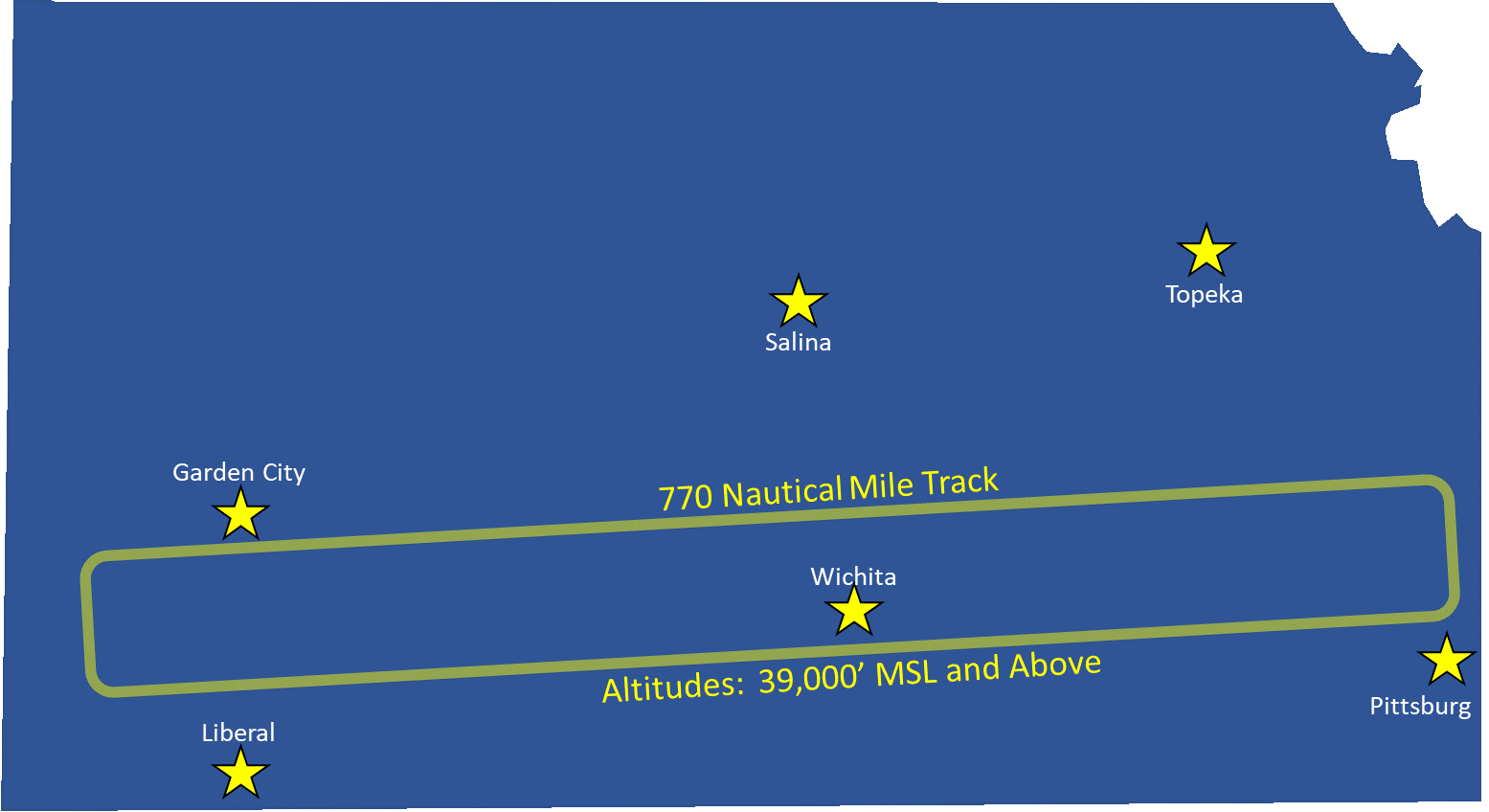

The Kansas Department of Transportation (KDOT) and the FAA have finalized an agreement to establish a supersonic transportation corridor (SSTC) for testing non-military supersonic aircraft. According to the Kansas Office of the Governor, the 770-NM “racetrack-shaped” corridor will “support sustained flight up to Mach 3.” Specific points of entry will be designated for aircraft entering the SSTC and operations will take place at or above 39,000 feet.
“The Kansas Supersonic Transportation Corridor will assist in the assessment of sound mitigating structural and engine designs as well as state of the art atmospheric acoustic modeling that eliminates the sonic boom and shapes the noise signature of an aircraft traveling faster than the speed of sound to a very low volume rumble,” said General Aviation Manufacturers Association (GAMA) CEO Pete Bunce. “The validation of these technological breakthroughs through the use of sophisticated ground acoustic and telemetry sensors will provide the necessary data to assist global regulators and policymakers in modernizing supersonic flight policies.”
Procedures for SSTC operations were written by the KDOT Division of Aviation, FAA Central Region, Air Route Traffic Control Center and Lemasters Group Consulting. KDOT has also partnered with Wichita State University’s National Institute of Aviation Research (NIAR) to collect noise data and telemetry from the aircraft. The gathered data is intended for use by the FAA and aircraft manufacturers for evaluating aircraft performance.
