















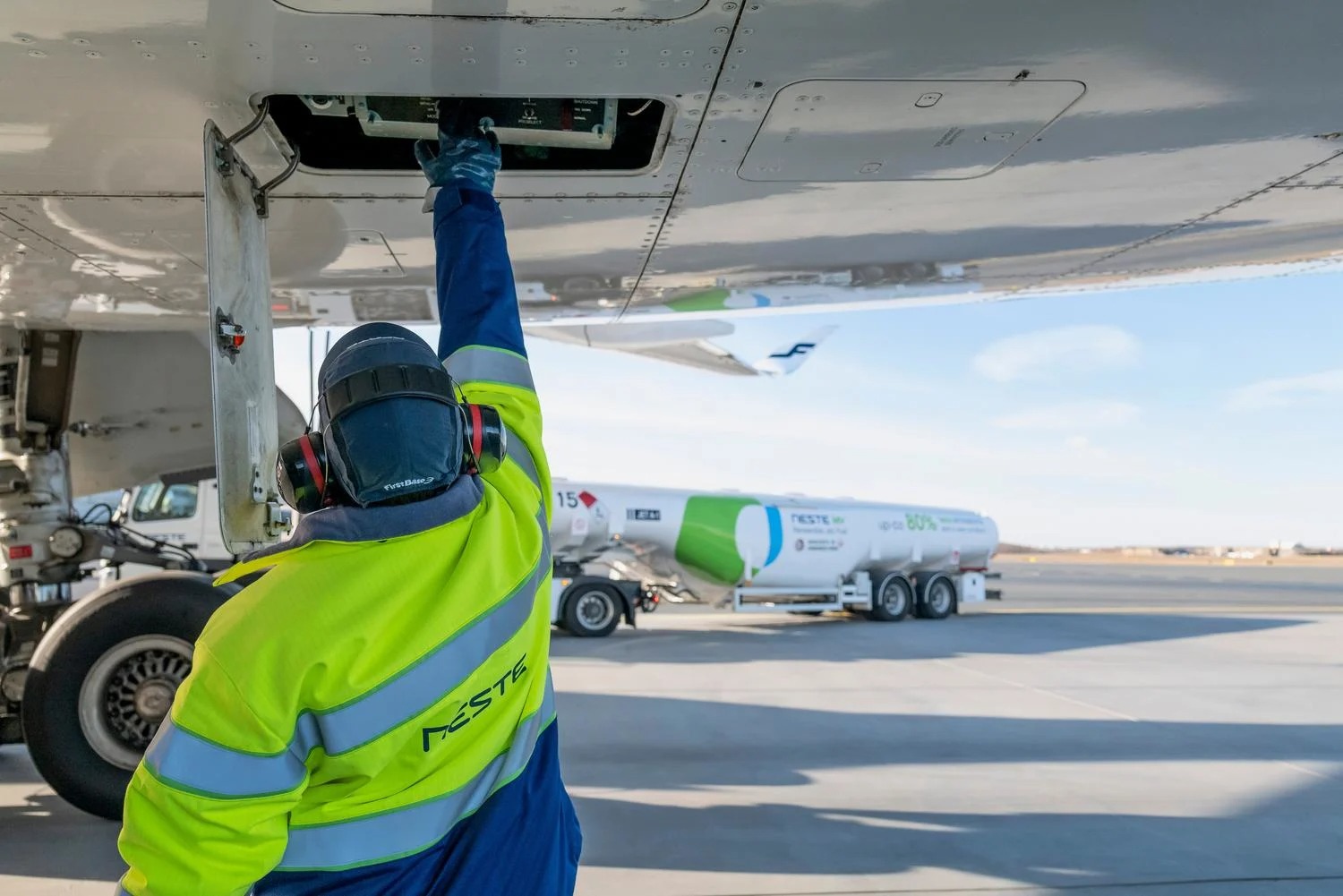

EASA released its latest ReFuelEU Aviation Technical Report Wednesday, providing the first comprehensive review of Sustainable Aviation Fuel (SAF) activity across the European Union. Covering data from 2024, the report identifies Finland, France, Germany, Spain, and Italy as the leading producers, with commercial-scale output already underway.
Neste’s Porvoo refinery in Finland, TotalEnergies’ facilities at La Mède and Grandpuits in France, BP’s Lingen refinery in Germany, Repsol’s refineries in Spain, and Eni’s new 400 kt-per-year Gela biorefinery in Italy account for much of the EU’s current SAF supply.
Development across member states
Development continues across other Member States. Estonia and Latvia are conducting a joint EU-funded study on regional production potential, while Poland’s Orlen and Romania’s OMV are building their first large-scale plants. Ireland published its first national policy roadmap in August 2025, and Luxembourg’s Cargolux and Lux-Airport have secured offtake agreements with Norsk e-Fuel. Malta, Lithuania, and Slovenia currently report no domestic capacity.
The report establishes 2024 as the baseline year for monitoring progress toward ReFuelEU Aviation’s blending mandates. It notes that SAF represented about 0.6% of aviation fuel supplied in 2024 and that meeting the 2030 target of 6% is feasible under optimistic production scenarios.
Market shifts and policy response
Synthetic fuel projects remain behind schedule, with no facilities yet at final investment decision stage. EASA projects EU output could reach between 1.4 and 5.9 million tonnes by 2030, depending on buildout rates and investment progress.
Global investment remains an active issue. Since the close of the summer, for instance, a major airline partnership announced the launch of a $150 million investment fund for the fuel, while in Europe, Shell scrapped a project that would have produced one of the continent’s largest processing facilities, citing the need to balance affordability with customer demands.
European Commission confidence
Regarding the Shell plant closure last month, European Commission spokesperson Anna-Kaisa Itkonen told AVweb that the commission remains confident that the bloc will reach the EU’s mandated 2034 SAF targets.
“Projections based on announced investments show that SAF production in the EU is expected to reach the mandated SAF targets until 2034,” Itkonen said. “the Commission also encourages SAF producers and airlines to produce and purchase SAF over and above the targets, respectively. Several measures allow to bridge the price gap between SAF and conventional aviation fuel. The Sustainable Transport Investment Plan to be adopted in the Autumn will aim to further facilitate long-term SAF offtake agreements.”
Itkonen also said the Commission is keeping a close eye on the fuels market as it attempts to develop in accordance with ReFuelEU plans.
“In particular, transparency for airlines on the price of SAF and the establishment of a competitive liquid SAF market will be key to incentivise airlines to buy SAF above the targets,” Itkonen said.


0 replies