















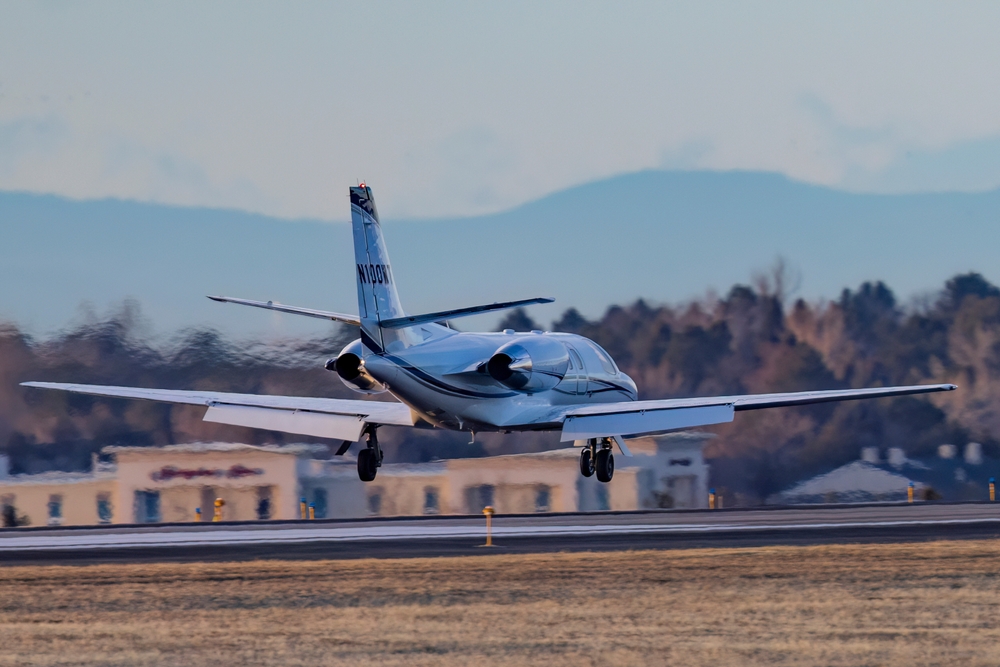

The FAA is ending exemptions that allowed pilots to operate certain Cessna Citation 500-series aircraft alone even though the aircraft are certificated for two-pilot operations. The policy takes effect Sept. 29 and covers Citation 500, 550, S550 and 560 variants, including the Citation I, II, S/II, V, Ultra, Bravo, Encore and Encore+.
The agency said it began a broader review of the program in 2024 after discovering that some organizations were offering training under another entity’s exemption. According to the FAA’s policy notice, the review found incomplete records, required flight training conducted in advanced aviation training devices contrary to exemption conditions and improper checks by designated pilot examiners, including falsified records.
The FAA said its review covered 14 Part 61 exemption holders, but did not identify them in the notice. Thirteen were either denied extensions or had their exemptions rescinded for noncompliance or failing to respond to agency information requests.
FAA Cites Accident Data
The FAA also reviewed 18 years of accident data and compared older Part 25 Citation 500-series jets that normally require two pilots but were being flown single-pilot under exemptions with Part 23 Citation models approved for single-pilot operation. The Part 25 group included aircraft such as the Citation 500, 550 and 560, while the comparison group included Part 23 CE-500 variants as well as the Citation Mustang and CitationJet families.
The agency said the Part 25 aircraft being flown under exemptions were involved in accidents at roughly twice the rate per aircraft of the Part 23 models being operated single-pilot. The FAA said its calculation was based on the number of aircraft rather than flight hours.
“The FAA finds that these exemptions do not provide an equivalent level of safety to the regulations and are no longer in the public interest,” the agency said.
The FAA cited two recent accidents as part of its review, including a May 2025 accident involving a CE-500 near San Diego that killed six people aboard and injured eight people on the ground. The FAA said the pilot had received an improper proficiency check six months before the accident. The NTSB investigation remains open and no probable cause has been determined.
The agency also pointed to a Dec. 18, 2025, Statesville accident, in which a Cessna 550 Citation II crashed while returning to Statesville Regional Airport in North Carolina. All seven people aboard were killed, including retired NASCAR driver Greg Biffle, his wife and two children, and father-son pilots Dennis and Jack Dutton.
Dennis Dutton was an airline transport-rated pilot and the only person aboard qualified to serve as pilot in command of the aircraft. His son held a private pilot certificate but was not qualified as the required second-in-command.
Industry Questions Immediate Rescission
The National Business Aviation Association and Citation Jet Pilots responded Friday by questioning both the process behind the rescission and the lack of advance notice to operators.
“NBAA supports the FAA’s responsibility to examine safety concerns and to take appropriate action as supported by the evidence,” NBAA Senior Vice President of Operations Heidi Williams said in an NBAA statement. “At the same time, the FAA’s decision to rescind these exemptions in full, effective immediately upon publication in the Federal Register and without direct notice to affected operators, raises serious questions.”
Citation Jet Pilots CEO Rob Balzano said the organization has submitted Freedom of Information Act requests seeking the data used by the FAA in its review.
“Our goal is to understand the facts and analysis behind the FAA’s actions so we can assess their impact on our members and respond constructively,” Balzano said.
Pilots who received single-pilot logbook endorsements through affected exemption holders may no longer use those endorsements to operate aircraft that otherwise require two pilots. The FAA said a previously completed Section 61.58 proficiency check may still be used to satisfy pilot-in-command requirements when the aircraft is operated with the required two-pilot crew.


0 replies