















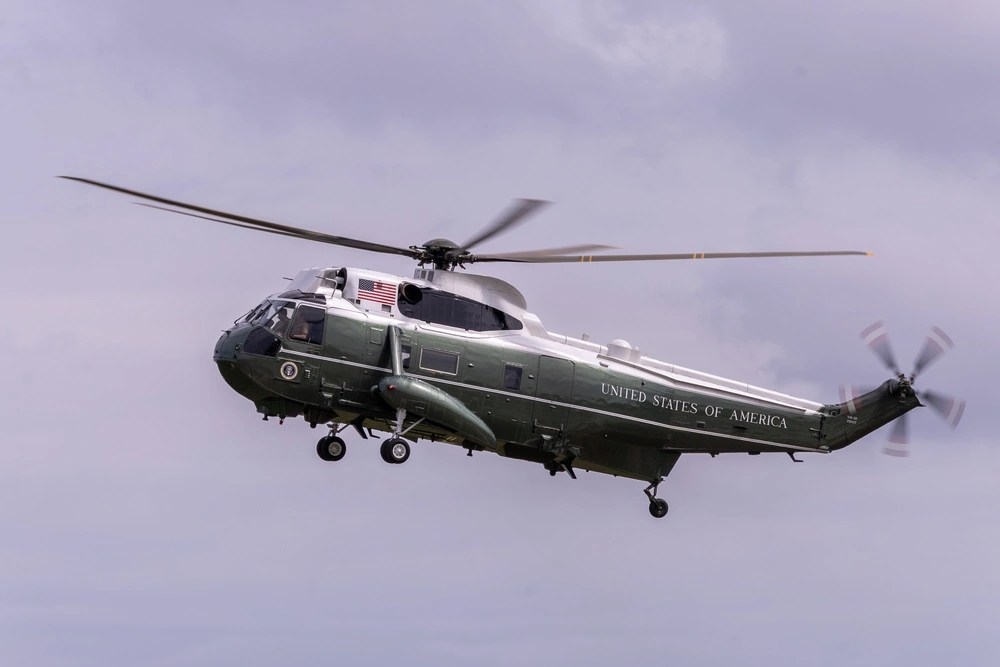

The FAA has established an additional notification procedure for Marine One departures following an August incident involving the presidential helicopter and a commercial aircraft near Ronald Reagan Washington National Airport (DCA). Under the new agreement, the National Capital Region Coordination Center will notify DCA’s control tower before Marine One departs the White House, the FAA confirmed Wednesday.
The procedure supplements an existing requirement for Marine One crews to notify controllers three minutes before departure. The advance warning allows controllers to suspend conflicting aircraft operations while the helicopter travels toward Joint Base Andrews. The National Capital Region Coordination Center includes FAA, military and security personnel responsible for monitoring and protecting Washington-area airspace.
August Incident Prompted Changes
The new agreement follows an Aug. 4 incident involving Marine One and a departing Envoy Air Embraer E170. According to an NTSB preliminary report, Marine One departed from a temporary landing site on the Ellipse near the White House as the regional jet was departing DCA. The aircraft came within 0.82 nautical miles laterally and 700 feet vertically of one another, although the NTSB said the distance met the applicable Class B radar-separation standard.
Previous Radio Problems
The NTSB investigation also documented communication difficulties preceding the event. Five days earlier, DCA tower personnel and Marine Helicopter Squadron One officials had met to discuss missed departure notifications and problems contacting controllers.
“HMX-1 advised that communications ‘had been spotty,’” the NTSB said in its preliminary report.
An alternate communication procedure was established during that meeting, but an attempt to use it Aug. 4 was unsuccessful. FAA recordings showed Marine One’s first transmission was not received and a second was unreadable.
A subsequent FAA analysis identified inadequate line-of-sight radio coverage between the Ellipse and the radio site. The agency relocated the helicopter-control radios to the top of the DCA tower, and subsequent flight checks found no communication deficiencies.
The NTSB investigation into the August incident remains ongoing.


0 replies