















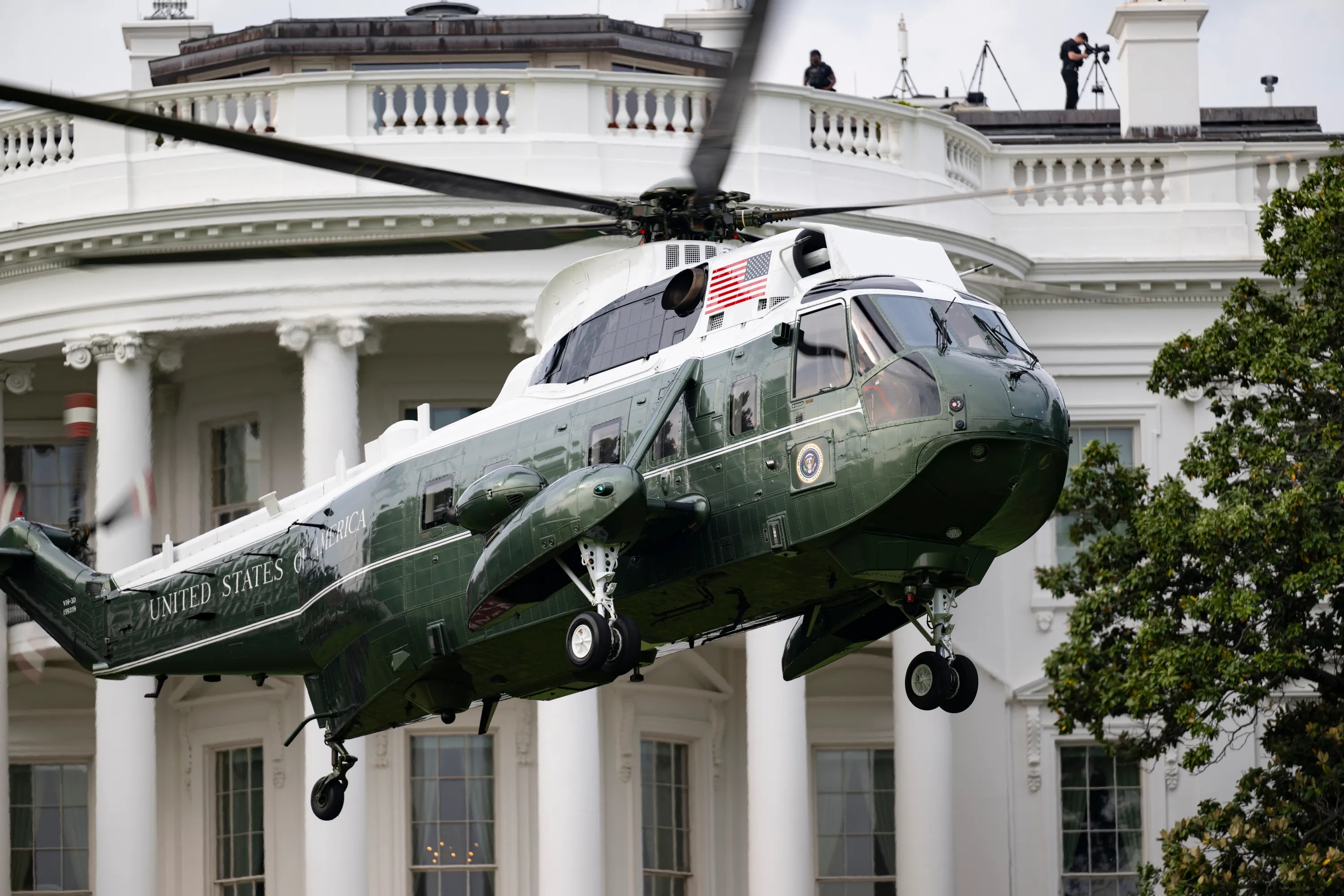

The FAA is investigating a possible loss of required separation Tuesday between Marine One and an Envoy Air regional jet near Ronald Reagan Washington National Airport. Flights at Reagan National had not been suspended before the presidential helicopter departed. President Donald Trump was aboard Marine One, and both aircraft completed their flights without further incident.
Aircraft Movements
Marine One departed the Ellipse near the White House at approximately 2:33 p.m. for Joint Base Andrews. Envoy Air Flight 3742, an Embraer E170 leaving for Pensacola, Florida, departed Reagan National at approximately 2:34 p.m. Sources told Reuters that the aircraft appeared not to maintain required separation minimums. Their flightpaths were not converging.
Republic Airways Flight 4700 was also inbound to Reagan National at the time. The Embraer E175 was approximately 3 miles from the airport when air traffic control instructed the crew to go around. The flight subsequently landed at 2:52 p.m.
FAA Investigation
“The FAA is investigating a safety incident involving Marine One, but it didn’t appear to be a dangerous close call and the aircraft weren’t apparently converging,” the agency said in a statement provided to Reuters.
Two sources told the news service that the FAA plans to convene a Safety Review Team to examine the occurrence.
The FAA established additional restrictions near DCA after the January 2025 collision between a regional jet and a U.S. Army Black Hawk helicopter. The accident killed all 67 people aboard the two aircraft.
The FAA subsequently established procedures intended to eliminate mixed helicopter and fixed-wing traffic near the airport. Essential helicopter operations, including presidential transport, remain permitted when specified separation from airplanes is maintained.


Everyone who has ever flown a plane will know that the only way two aicraft can colide is if they are at the same altitude. This discussssion would be more relevant if that was the case with Marine One. Clearly, the is was not even a near miss.
At least this can’t be blamed on general aviation!
This actually makes me laugh. The inability of military to coordinate with DCA just shows how bad leadership is in DC.
Even more hilarious, is the underlying insinuation that its someone elses fault, other than those directly responsible!