















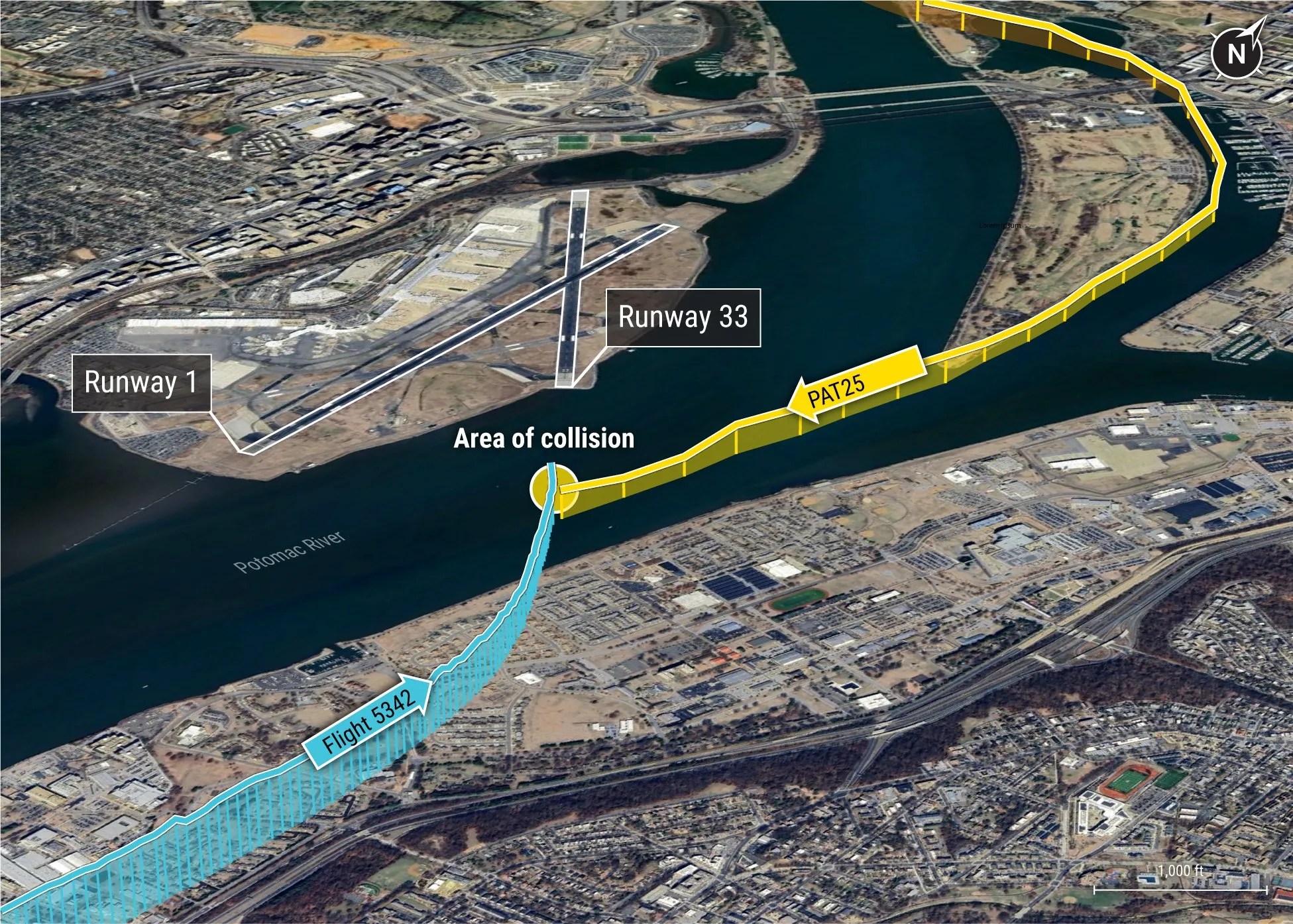

The U.S. Army released findings Thursday from its investigation into the January 2025 midair collision between an Army Black Hawk helicopter and a regional jet near Ronald Reagan Washington National Airport that killed 67 people. The investigation, completed in May, identified multiple safety failures involving air traffic control communications, helicopter operations and military oversight.
Communication and Altitude Failures
Investigators identified two broken radio transmissions as a key contributing factor that prevented the helicopter crew from receiving critical traffic information. The report also cited inaccurate altitude indications, limited visibility while using night-vision goggles and deficiencies in pilot training. Investigators found that the Black Hawk’s ADS-B Out equipment was improperly configured and had not been transmitting aircraft position data.
“In agreement with the NTSB, the inability to hear clear and concise radio transmissions did directly contribute to the accident,” the Army report stated.
Army Outlines Safety Changes
The investigation also found that the Army had not adequately tracked near misses or coordinated with the FAA to identify recurring hazards around Washington. Investigators noted that the helicopter route could provide as little as 75 feet of vertical separation from aircraft approaching Reagan National’s secondary runway. The findings reinforce the NTSB’s conclusions, which identified failures in FAA airspace design and safety management as primary causes of the collision.
In a fact sheet, the Army said it had inspected 3,585 helicopters for ADS-B configuration issues and introduced recurring inspections to verify proper operation. The service has also expanded training on fixed-wing approach and departure paths at Reagan National Airport and is pursuing an agreement to share safety data with the FAA. Other changes, including additional flight-data monitoring and updates to helicopter operating manuals, remain underway.


I’ve flown with ADS-B In/Out since 2017. It’s not a complete solution to collision avoidance. Sometimes I’ve experienced false alerts. But it’s a lot better than no collision avoidance technology. Many times I’ve detected potential conflicts that I couldn’t see with my eyes and performed avoidance maneuvers. It might have prevented this accident if both aircraft were squawking ADS-B In/Out. TCAS, Hybrid TCAS and ACAS X are better collision avoidance technologies but they are expensive to install in aircraft: $150,000 - $200,000 vs. a $3,000 - $5,000 ADS-B In/Out installation. Hopefully, advancing technology will bring the cost down for NextGen ACAS X.
Advancing technology will also bring more opportunities for configuration errors. I once took off in a light aircraft into a blinding mist the visibility forecast completely missed. Once up, I needed GPS to get back to the airport, but the previous renter had really messed up the device’s configuration. I could not figure it out, so I used my handheld VOR to to get back. Technology isn’t the whole answer.
I believe the most important take is that we should never allow military training in these congested areas. We should locate these helicopters and personnel in one of the many excellent locations that we have designated for training. Military operations should never be mixed with civilian operations unless it is absolutely necessary and approved by top leadership people that are willing to tke responsibility for any accidents.
Much training can be done in designated training areas, but sometimes for a specific mission it would be best done in the mission’s location.
I did consider that it might be necessary in very unusual circumstances. That is why it should be authorized by the highest level of command. Mixing military and civilian traffic is very dangerous and should be avoided whenever possible. That is why most traffic is barred from MOA’s.
What everyone seem to be missing is that the ICAO rules for crossing airways or routes was never followed when the helicopter route was established under the approach corridor. Simultaneous operations of those routes should have never been permitted. This accident is solely the FAA’s Fault!
No traffic is barred from MOAs. The FAA’s Aeronautical Information Manual (AIM), paragraph 3-4-5, permits VFR pilots to operate through MOAs.
Prohibited Area is the only one that all traffic is barred.
I have been flying for sixty years and I have never been allowed to enter an MOA while on instrument flight rules. You are advised to go around an MOA when using flight following. I have been cleared to enter a prohibited area during IFR if the area is not active.
ATC must not like you. There are so many airports within MOAs, including mine. If what you say were true, I could never takeoff.
If MOA is active, ATC will not allow IFR traffic only to go through. If you are VFR, you can fly through MOAs all you want, you are then accepting the risk of encountering military traffic. Restricted and Prohibited airspace are another issue and you cannot pass through restricted without an ATC clearance.
The first events as reported shortly after the collision were the blackhawk busted altitudes in a big way, and the pilot flying altimeter disagreed with that of the check pilot. The pilot flying should have called the clueless check pilot and called ‘knock it off’ and returned to base or landed on the spot. My overall impression of the military flight was that the crew didn’t fly the route as required, failed to comply with clearly defined limits of the flight, and failed to communicate while in the air.
So do the training without other traffic in the area.
And record audio and flight parameters for review to evaluate crew performance and advisability of the procedure. I think FAA and TC do that, PWA did it at Castlegar BC (decided turning in the adjacent valley was too risky),
Hardly.
But your information does say FAA did violate ICAO rules.
There was not scheduled traffic. ATC redirected the incoming flight at the last minute. But still would have been ok had the helicopters GPS has been working right. I have heard of folks saying GPS was configured incorrectly. My GPS just works. Configure for flight plan, but it always tells me altitude.
Besides the obvious equipment issues, something else really stood out. Each time ATC pointed out traffic to the Army helo, the instructor immediately responded with “traffic in sight…” How on earth did he have time to ask the other pilot if they had the traffic in sight in that microsecond before keying his mic? As airline pilots, we are trained to use a crew concept, and ensure both pilots see the traffic before confirming it in sight and taking on separation responsibility. Aircraft in congested airspace (especially at night) are difficult to differentiate. It speaks to an astonishing lack of crew coordination.