
















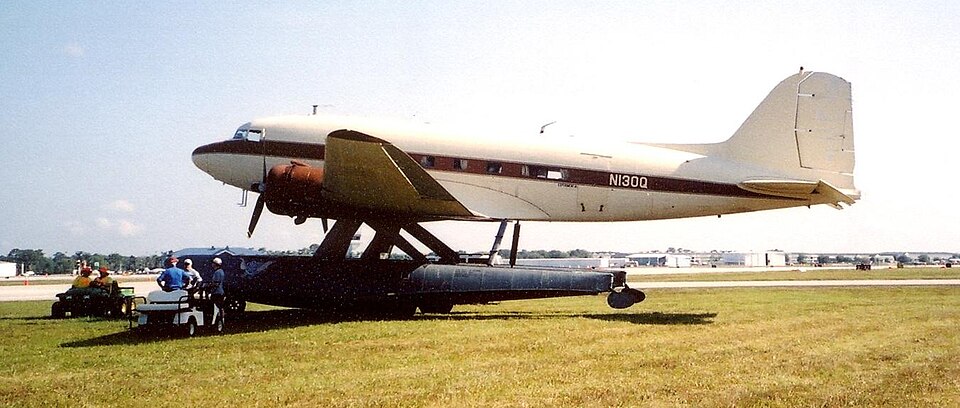

A Maine aviation preservation group is working to secure the future of the world’s only A Maine aviation preservation group is raising money to acquire a stake in the world’s only flying Douglas DC-3 equipped with amphibious floats, with plans to keep the historic aircraft airworthy and bring it to major aviation events.
The Maine Center for Classic Aviation (MCCA), a nonprofit based at Thompson Memorial Field in Pittsfield, Maine, has launched a $100,000 fundraising campaign to become a shareholder in DC-3 N130Q. The aircraft is currently owned by HBF Inc., and the group hopes to secure its long-term future in Maine while supporting maintenance, restoration and educational outreach.
The aircraft, originally built as a C-53D Skytrooper in 1943, was converted to an amphibian by Maine aviators Dick and Max Folsom using surplus World War II-era floats. It first flew on floats in 1990 and has since become a fixture of Maine’s aviation heritage, according to AOPA.
N130Q performed demonstration flights at the 2026 International Seaplane Fly-In on Moosehead Lake in Greenville, Maine, in September. Pilots Eric Zipkin and Sam Canders flew the aircraft during the event. In an interview with the DC-3 Society, Zipkin said the aircraft was airworthy but needed further restoration to improve its reliability.
Canders, an MCCA director who is organizing the fundraising effort, has emphasized the importance of keeping the aircraft in Maine. In an October interview with the Moosehead Lakeshore Journal, he described N130Q as an important symbol of the Moosehead Lake community.
Vintage Aviation News reported that N130Q flew to Auburn-Lewiston Municipal Airport on Oct. 23 for winter maintenance, including control-surface fabric replacement, engine work and brake modifications. The publication also reported that MCCA is working with Dirigo Aerospace Solutions, led by DC-3 mechanic Mark McGhee.
Longer-term plans outlined in the fundraising campaign include repainting the aircraft and bringing it to EAA AirVenture in Oshkosh, Wisconsin. MCCA also hopes to keep the airplane flying in Maine, preserving its connection to the region’s seaplane heritage.


0 replies