

Image: NOAA
NOAA’s Search and Rescue Satellite Aided Tracking (SARSAT) division is taking steps to promote the registration and testing of 406 MHz emergency location devices with a special awareness day. #406DAY18 was held Friday, April 6. In addition to government organizations, the awareness push is being supported by device manufacturers and partner groups across aviation, boating and outdoor adventure communities.
Federal law requires that all emergency position indicating radio beacons (EPIRBs), personal locator beacons (PLBs) and emergency locator transmitters (ELTs) be registered with NOAA SARSAT. Registration is free and can be done online or by contacting the NOAA SARSAT Beacon Registration Database at 1-888-212-SAVE (7283). Registration should also be updated if the aircraft or device is sold or when owner information changes.
Besides registration, SARSAT says it would also like to educate the GA community about how to prevent false alerts—which also includes proper test procedures—and what to do if a device is accidentally activated. According to SARSAT, false alerts from accidental activation of 406MHz ELTs by aircraft operators is a major issue, with more than 8,500 false alerts recorded in 2017. If a beacon is accidentally activated, the U.S. Air Force Rescue Coordination Center should be contacted at 1-800-851-3051. They’ll need the beacon’s ID to cancel the false alert.
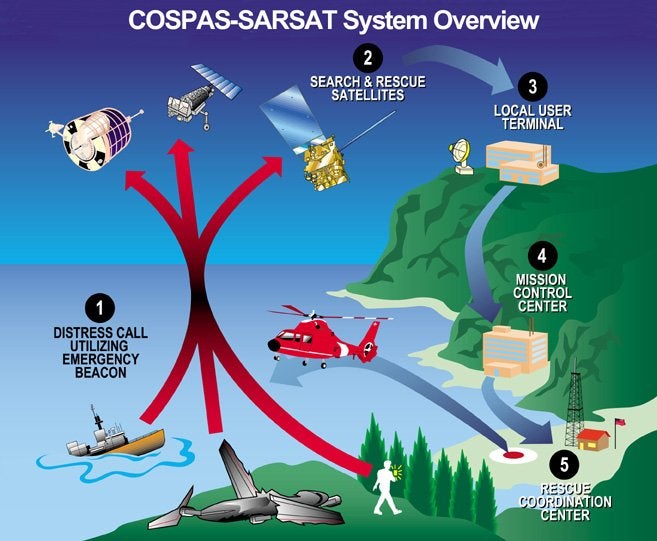
Since the first Cospas satellite went up in 1982, SARSAT reports that more than 43,000 people around the world have been rescued with the Cospas-Sarsat program. Cospas-Sarsat —of which NOAA-SARSAT is an integral part—includes 41 nations and two independent search & rescue organizations.