
















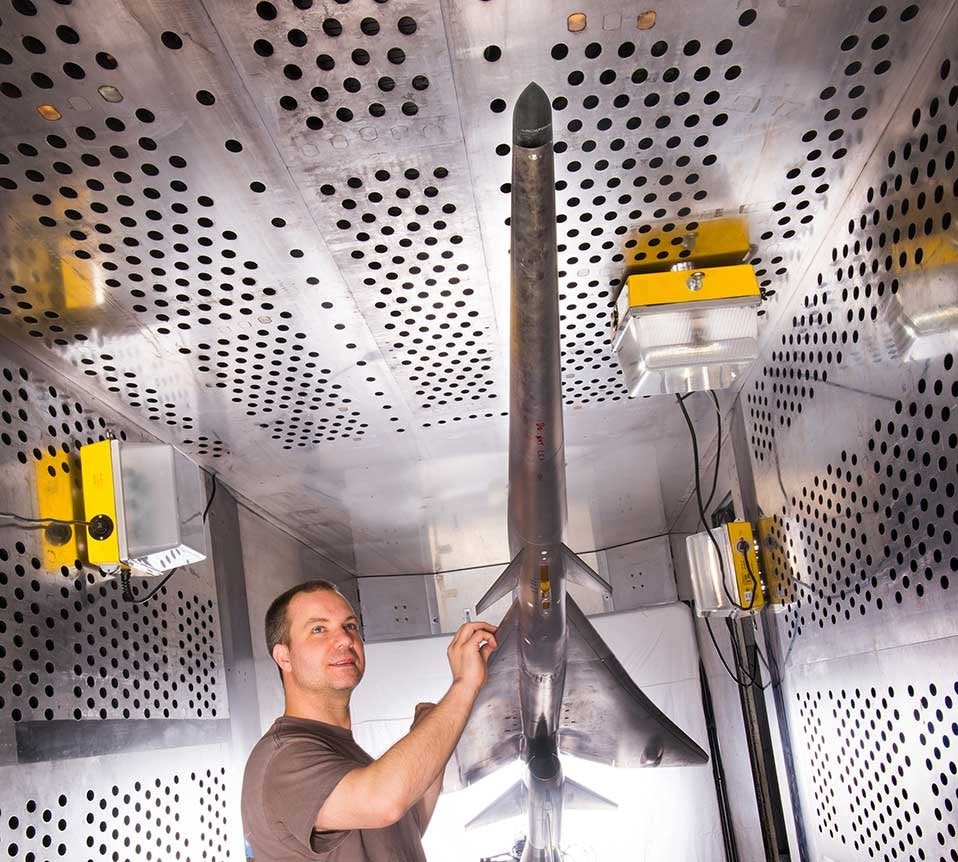
NASA’s Quiet Supersonic Technology (QueSST) preliminary design model is entering an eight-week testing phase at NASA’s Glenn Research Center in Cleveland, Ohio, the agency reports. The Glenn Research Center wind tunnel will simulate speeds from Mach 0.3 to Mach 1.6 to ensure smooth airflow into the engine during all phases of flight and to confirm that lift, drag and side forces on the airframe at various angles of attack, sideslip and Mach number are within expected ranges.
Supersonic flight by civil aircraft in the United States is prohibited due to the disruptive sonic boom created by existing supersonic aircraft designs. Limitation of supersonic travel to oceanic airspace is thought to be a major factor in the absence of a market for supersonic business aircraft. “Our unique aircraft design is shaped to separate the shocks and expansions associated with supersonic flight, dramatically reducing the aircraft’s loudness,” said Peter Losifidis, QueSST program manager at Lockheed Martin Skunk Works. “Our design reduces the airplane’s noise signature to more of a ‘heartbeat’ instead of the traditional sonic boom that’s associated with current supersonic aircraft in flight today.”
Lockheed Martin won a contract to design the QueSST model in February 2016 as the first phase of a supersonic quiet flight demonstrator. If additional funding for the project is approved, NASA says they expect to award an additional contract for final design, build and testing of a flying low-boom demonstration aircraft. NASA hopes to see a QueSST X-plane take flight around 2020.
Photo Credit: NASA

