
















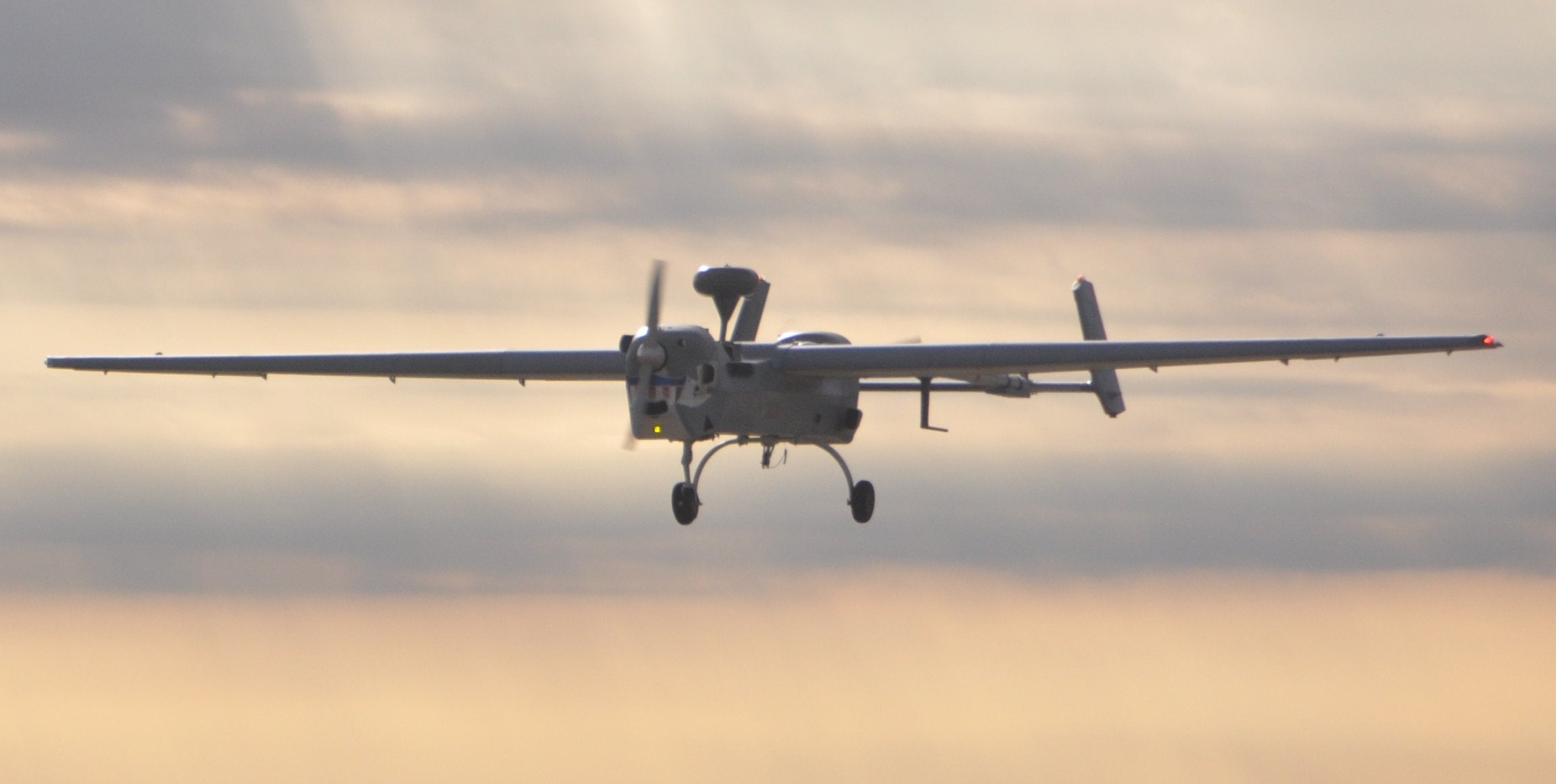
The Army’s longest-serving unmanned aerial system retired this month after a final flight at Fort Hood in Texas. Operators of the Hunter, a fixed-wing unit similar in size to a two-seat piston airplane, enjoyed a last demonstration flight during a ceremony Dec. 16 at Robert Gray Army Airfield. The UAS is among the early generations of unmanned aircraft produced for the military long before drones hit the mainstream. It was the first of its kind to fly in Army operations, starting in 1995 in Fort Hood and Fort Huachuca, Arizona, according to the Fort Hood Sentinel. Other Army bases eventually employed the Hunter, which also was used for reconnaissance missions in the Balkans and the Middle East.
According to its manufacturer, Northrop Grumman, the latest variation of the Hunter is the MQ-5B, which features a twin-tail design and two engines, one in the rear and one in front. It can fly for 21 hours at altitudes topping 18,000 feet. It has redundant systems and can be controlled by other unmanned aircraft for extended operations in remote areas. “The system is really built on redundancy,” one Hunter operator told the Sentinel. “There’s always another system that can take over if one part fails. The program was never supposed to last this long, but the Hunter just kept doing everything the Army wanted it to do.” Still, its time has come, and the Hunter will be replaced by an upgrade that offers greater speed, endurance and altitude — the Gray Eagle UAS made by General Atomics.

