
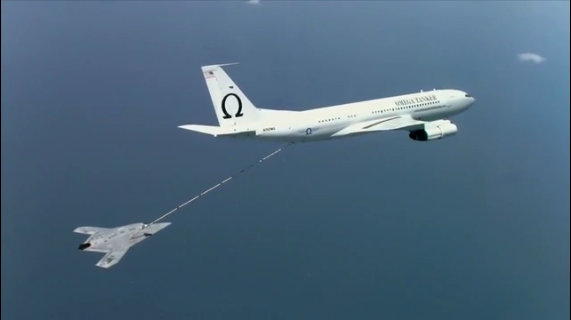
The X-47B unmanned aircraft successfully demonstrated the first-ever fully autonomous aerial re-fueling on Wednesday, Northrop Grumman has announced. The X-47B launched from the Naval Air Station at Patuxent River, Maryland, and flew to a test site offshore. The UAS flew in close formation flight with an Omega K-707 tanker, and upon clearance from the tanker crew, it maneuvered into position behind the tanker and successfully engaged the refueling gear, called the drogue. The X-47B took on more than 4,000 pounds of fuel, then autonomously disengaged the drogue, maneuvered away from the tanker, and returned to base.
“We are very pleased with the outcome of this first round of probe-and-drogue flights with the X-47B,” said Pablo Gonzalez, manager of the test program for Northrop Grumman Aerospace Systems. “The autonomous aerial refueling system and X-47B both performed as expected.” The test represents a “tipping point,” Gonzalez said, showing that autonomous aerial refueling is now feasible. The refueling test is expected to be the last mission for the X-47B, which will be donated to a museum. The program wonthe Collier Trophy in 2013.With the completion of this program, the Navy says it will continue to develop its future unmanned carrier-based platform, known as UCLASS, forUnmanned Carrier-Launched Airborne Surveillance and Strike system.