
















Image: ESA
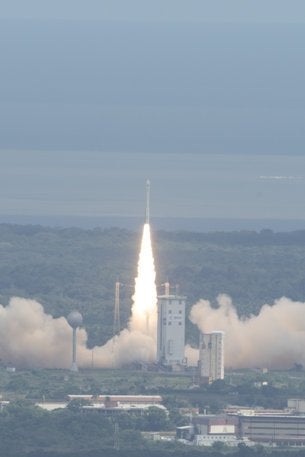
The European Space Agency had a successful test of its unmanned mini-spacecraft Wednesday, launching theIntermediate eXperimental Vehicle and recovering it after splashdown in the Pacific Ocean. The design of the IXV spaceplane, as the ESA calls it, will ultimately result in a reusable spacecraft. The big push now is to develop re-entry capability and data gathered during Wednesday’s test will be used toward that end. The 16-foot-long IXV lifted off at 8:40 a.m. Eastern Time from Europe’s Spaceport in Kourou, French Guiana, atop a Vega rocket. It separated from the rocket at an altitude of about 211 miles above the earth and climbed to 256 miles before beginning its descent, reaching supersonic speeds and decelerating with parachutes before splashdown.
The results of the flight, to be released in about six weeks, will be another step in the ESA’s Programme for Reusable In-Orbit Demonstrator (Pride), a reusable spaceplane that will be able to launch on a Vega rocket and land on a runway. “IXV has opened a new chapter for ESA in terms of reentry capabilities and reusability,” Jean-Jacques Dordain, ESA Director General, said in the agency’s announcement on the test flight. “ESA and its Member States, together with European space industry, are now ready to take up new challenges in several fields of space transportation, in future launchers, robotic exploration or human spaceflight.”

