
















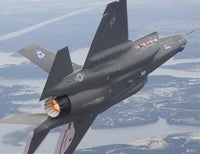
A report by the Pentagon’s director of operational test and evaluation highlights numerous shortcomings with the F-35, combat concerns raised by pilots, and the jet’s general lack of readiness for training exercises. The report was prepared last month and made public last week. It notes that “due to design, the pilot-vehicle interface causes increased workload” and includes quotes from pilots critical of visibility from the cockpit. One said, “A pilot will find it nearly impossible to check six under G.” There were other issues.
The report also found problems with the system’s helmet display, citing “latency” and “jittery” behavior as well as focal problems. The F-35, it said, was also prohibited from flying at night or in instrument meteorological conditions. And its mission abort rates were found to be four to seven times higher than the program’s goal prior to training. Angle of attack, g-loading, speed and altitude were all restricted. The aircraft “is currently prohibited from flying close formation, aerobatics, and stalls” typically flown during transition training. According to the report, “The F-35A does not yet have the capability to train in these phases, nor any actual combat capability, because it is still early in system development.” According to the evaluation, the aircraft is currently “approximately one-third of the way through development.” The report represents an assessment that was requested in mid-2010, when training was planned to begin in August 2011. Click here for the full report (PDF).

