















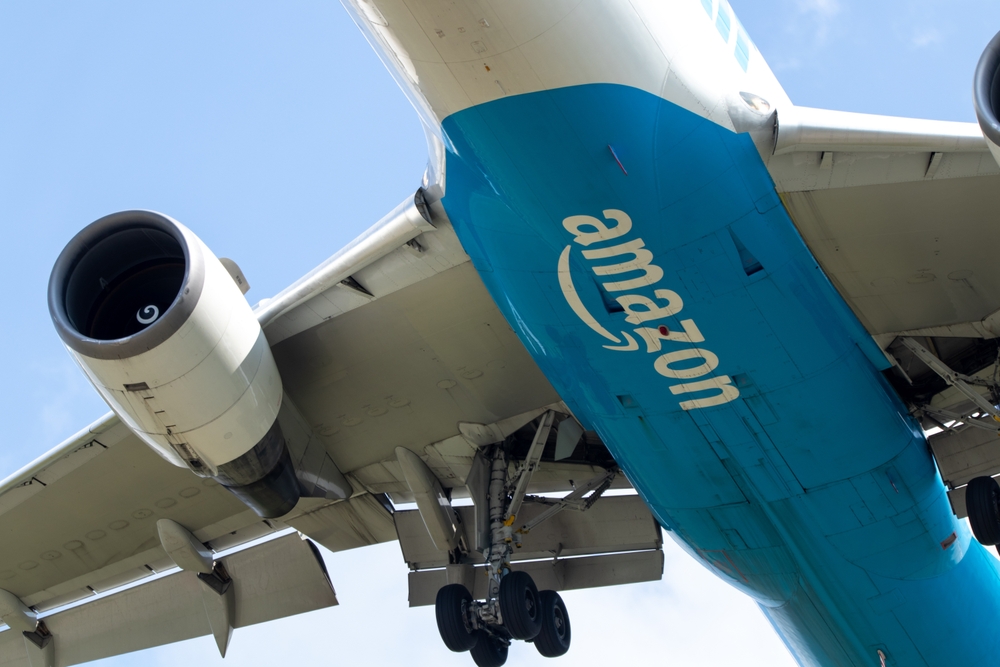

At least five people were killed and five others injured Sunday after a Boeing 767-300 freighter operating for Amazon Prime Air overran a runway at Miami International Airport, struck several vehicles and caught fire. According to the FAA statement, 21 Air Flight 7598 had arrived from Luis Muñoz Marín International Airport in San Juan, Puerto Rico, when it overran the runway at about 2 p.m. local time.
Aircraft Crossed Airport Perimeter
The aircraft landed on Runway 30 and continued beyond the end of the runway. Tracking data from Flightradar24 showed the 767 traveling at a ground speed of 112 knots as it exited the usable portion of the runway. The aircraft crossed a road outside the airport perimeter before coming to rest near a parking area.
More than 60 Miami-Dade Fire Rescue units and about 200 emergency personnel responded. Authorities said five people were killed and five were injured, including three who were in critical condition. The two pilots were among those taken to hospitals. Fire officials said occupants of vehicles struck by the aircraft were also trapped.
Investigation Underway
The accident resulted in a full ground stop at Miami International. Two of the airport’s runways had reopened by Sunday evening, although hundreds of flights were delayed or canceled.
The NTSB has sent an investigative team led by Chair Jennifer Homendy. Investigators have not identified a cause, and the agency is expected to examine the aircraft’s landing, speed, braking and mechanical condition along with weather and other operational factors.


Classic case of failure to initiate a go-around…
Other media report that wind suddenly shifted to a tailwind, crew had difficulty planting airplane on runway.
As a retired Naval Aviator, experienced Navy mishap investigator, ATP and instructor pilot, it appears, given information that the acft landed far down the rwy, well past the Touchdown Zone, that the PAC couldn’t stop the acft in the rwy remaining resulting in a Runway Excursion.
Although unlikely, contributing to this mishap might be the failure of the thrust reversers and brakes – single or dual mechanical failure.
However, my sense is this mishap will mostlikely be a poor decision to try to land the acft well past the first one third of the rwy (we teach Navy pilots to go-around if you can’t land in the first one-third of the rwy) and stop the acft with the runway remaining. Departing the rwy at 112 kts. indicates that they may have landed long and fast which resulted in this mishap.
While I’m only speculating based on the limited information I have, the primary casual factor will be pilot error, Again, poor judgment was exercised in deciding to land without adequate rwy to stop the acft. A classic Runway Excursion.
Some media report that wind changed suddenly to a tail wind and crew couldn’t get airplane planted quickly.
Probably should have gone around. Initial error probably was to try to land in that weather.
Keith,
Well, if they knew they were landing with a tailwind, even more reason to wave-off (go-around) to set up to ensure the landing was going to be in the Touchdown Zone.
We’ve all had similar situations. I know I had flying the P-3C around the world, especially out of Adak, AK.
About a year ago, we had a P-8 acft depart the rwy upon landing at Kanehoe Bay. The PAC floated down the rwy touching down well past halfway and eventually ran off the runway into the Bay. Again, they landed very long and fast and just didn’t have enough rwy to stop the acft. It was a tragic Runway Excursion that also cost the Navy the total loss of the acft. Primary casual factor - pilot error, poor judgment.
Unfortunately, these are the facts and they’re undeniable.
It was an unstable approach from 5 miles out until they went off the runway. Winds. Right Gordo.
As an experience Navy mishap investigator, ATP and instructor, I agree.
We all know flying is a combination of six (6) elements - airwork, headwork, knowledge, practices, procedures and techniques. Clearly, at five (5) miles out, unstable and not on speed and perhaps not properly configured, it’s clear poor airwork was evident, but even more troubling, was poor headwork. The combination of poor headwork and airwork – clearly pilot error - were the primary causal factors for this mishap. Flying is as much about “stick and rudder” and it is about sound judgment. Without question, there was very poor judgment in attempting the landing and even more so once they touched down. Unfortunately, the result was tragic.