

















Industry safety groups are renewing warnings about the risks of circle-to-land approaches, citing accident history and ongoing data analysis that highlight hazards with the maneuver.
A review conducted through the Aviation Safety Information Analysis and Sharing (ASIAS) program found that circling approaches—while sometimes necessary due to runway alignment, terrain or wind—require low-altitude, low-airspeed maneuvering at a critical phase of flight, increasing exposure to loss of control and controlled flight into terrain.
Between 2008 and 2023, 10 accidents involving Part 91 and Part 135 operations occurred during circling maneuvers, resulting in 17 fatalities. Those accident types continue to dominate the risk profile.
The ASIAS study points to several contributing factors, including unstable approaches, high pilot workload and loss of situational awareness. Data from voluntary safety programs also link circling maneuvers to excessive descent rates, low power conditions and go-arounds.
Investigators noted that circling approaches are concentrated at certain airports where operational constraints make straight-in landings less practical. Pilots operating into those locations are urged to conduct thorough preflight and approach briefings and understand airport-specific procedures and limitations.
Safety officials stress that while circling approaches remain a necessary tool, they demand disciplined execution, strict adherence to stabilized approach criteria and continuous situational awareness to reduce risk during one of aviation’s more challenging phases of flight.

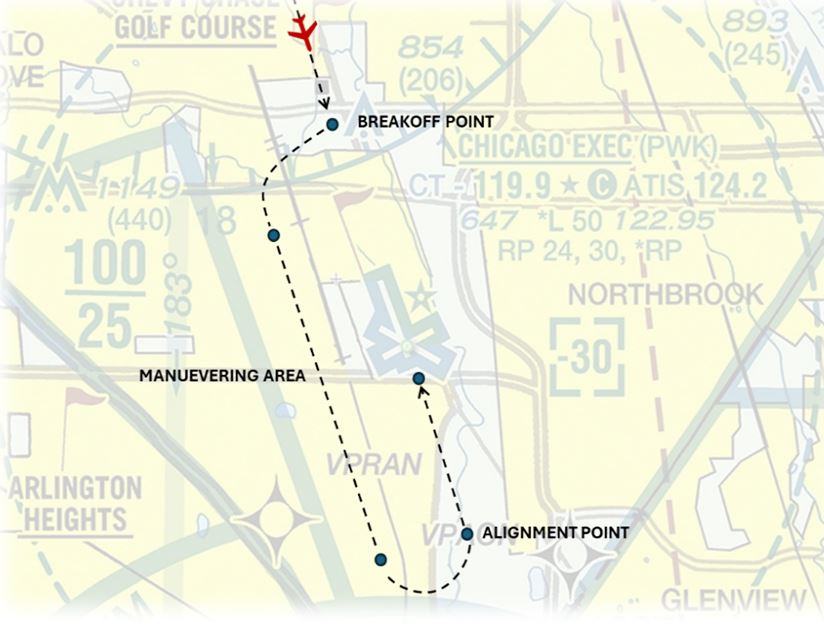
Maybe the FAA needs to change its interpretation of a circling approach during sim training from a minimum of a 90 degree turn to 180 degree turn. The RNAV/ILS 16 into PWK is a perfect example, which is what is in the analysis published. Better yet how about just figuring out and actually training in sim how to fly a traffic pattern in a jet. You would be amazed how many FO’s I have had who could not figure out how to fly a simple (private pilot) traffic pattern in a jet. No excuse for this since training for a type rating is done to ATP standards. I wonder how many multi-engine CFI’s actually teach a traffic pattern in a multi-engine trainer. Of course they shouldn’t have to since this is a private pilot skill, not something that has to be taught at the ATP level.
Thanks for the outstanding work you folks are doing covering the world of aviation. I am about to turn 80, only accumulated 30,000+ hours flying a few big planes so what do I know. Only have ATP licenses from the UK,USA and Japan. Only flown the 727, 737, 747, 757, 767, DC10, MD80, A300 Airbus, UC-123 (vietnam), OV10 (Vietnam, Laos, Cambodia), C5, C5 Flight Test Pilot, C-130/B and so on so what do I know. But, it seems if someone is not being taught how to do a circling approach someone is not doing their job and might that be the FAA?
Remember the Boing 737max crashes killing 346 souls? Who grounded the planes?
Not the FAA Certification team. Why?
Not the FAA Administrator. Why?
Not the head of the DOT? Why?
Oh yes, it took the President of the USA to ground the planes.
What is leadership?
Wow, what teamwork!
Oh yes, I have to mention this to any Doubting Thomas out there.
Who am I?
A nothing, just a pilot, a dime a dozen. covey42@gmail.com
The major airline that I flew for for 31 years had always prohibited circling approaches in less than VFR weather. This was part of our ops-specs. Other airlines may have done the same.
In the USAF, the airlift command did fly and train the circling approach, but we also flew pilot trainers in the real airplane, which made this training possible. For the first third or so of my career, simulators were not capable of performing the circle-to-land maneuver due to limitations of the visual system. It was only with the advent of visual systems with greater than 180 degrees of visual coverage that circle to land maneuvers could be realistically performed.
Now, of course, we have such systems. And the need for training and practice on visual approaches and the circle-to-land maneuver has been made obvious by, among other events, the Asiana crash at SFO. This is important in an era when many wide body international pilots have no more than one opportunity per month to actually land the airplane.
An interesting aside: in the beginning of the jet age, when the wind at Idlewild (later JFK) made use of the 13’s necessary, the procedure was to fly an approach to 04 and circle left to 13L. There were enough close calls (with the ground) doing this that American Airlines worked with the Port Authority and the FAA to create what came to be known as the Canarsie approach - the VOR 13L/R, which still exists (either with the VOR or, now, also as an RNAV) to this day.
To make matters worse the vast majority of instrument approaches are to airports in Class G airspace. While you are chewing your fingernails in a circling approach with 1 mile vis you can come face to face with a legal VFR aircraft in the same traffic pattern. One SM and clear of clouds is all that is required in G airspace. Over most of these airport Class E airspace starts at 700’ AGL.
It is long past time when instrument approaches should be conducted in E (or D) only.
When I learnt to fly, doing 360s on the approach were ABSOLUTELY verboten. Did I miss some down grade of safety, somswhere?