















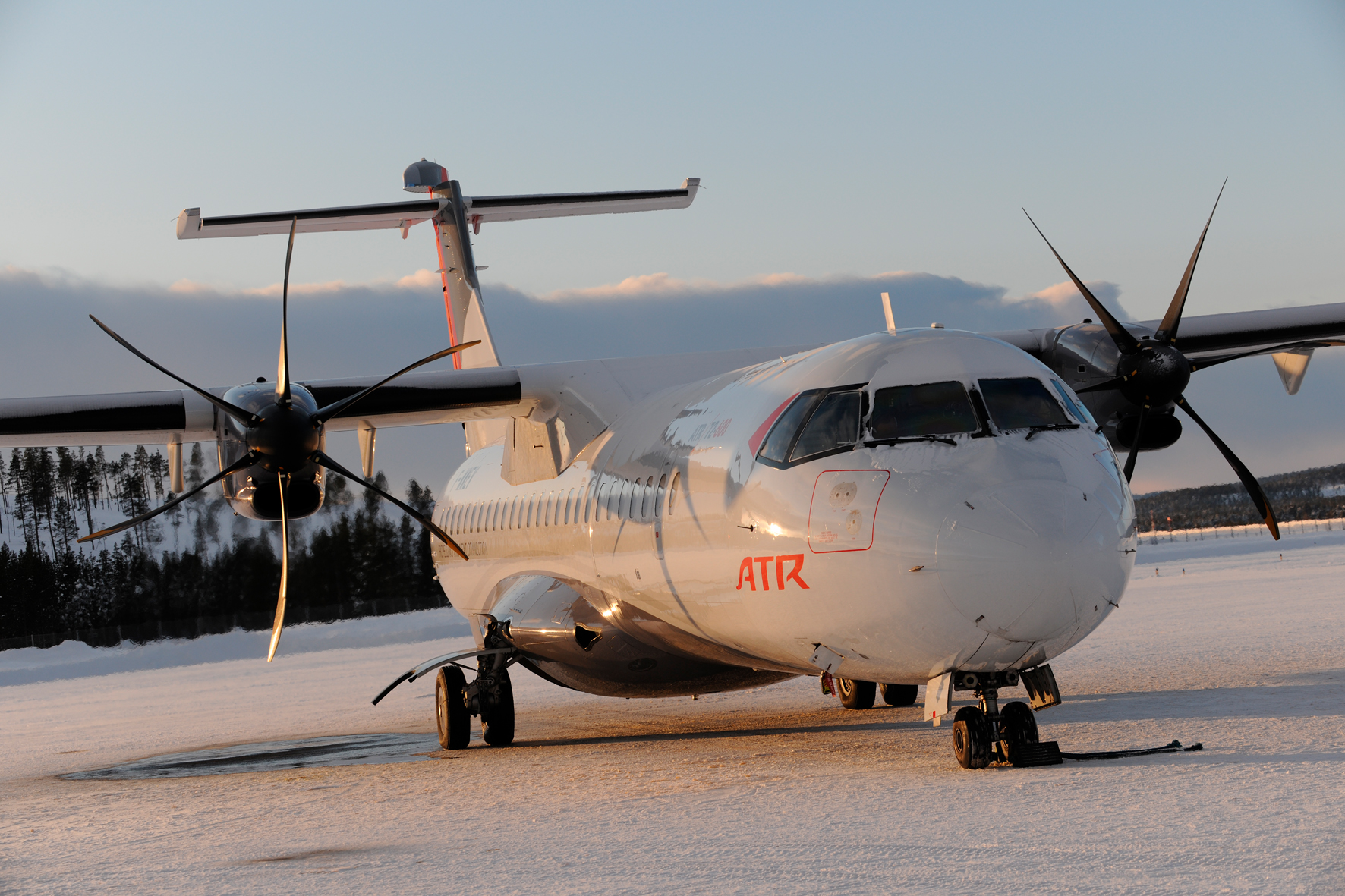

The European Union’s Clean Aviation Joint Undertaking program announced that it has selected ATR to lead two projects aimed at demonstrating hybrid-electric propulsion on a regional aircraft. The manufacturer said it will utilize a modified ATR 72-600 as a flying test bed, with which it plans to complete the first flight of a hybrid-electric regional aircraft by 2030. The manufacturer said the initiative will combine new propeller systems and electrified aircraft systems to support the EU’s climate goals.
ATR has been involved with prior sustainability initiatives in the recent past, such as when a modified ATR 72-600 became the first airliner to complete a flight with tanks fully filled with sustainable aviation fuel (SAF).
The two programs include HERACLES, which will define a regional aircraft concept integrating hybrid-electric propulsion, high-performance batteries and a thermal engine compatible with 100 percent sustainable aviation fuel, and DEMETRA, which will conduct flight tests of the technology on the ATR 72-600. Industry partners on the effort include Safran and RTX companies Collins Aerospace and Pratt & Whitney Canada.
“This is more than a technological demonstration, it’s a bold commitment to the future of regional aviation,” ATR CEO Nathalie Tarnaud Laude said.
The EU says the Clean Aviation Joint Undertaking is its flagship research and innovation program for sustainable aviation. It operates as a public-private partnership under Horizon Europe. With a €4.1 billion budget, it aims to reduce greenhouse gas emissions of regional and short-range aircraft by at least 30 percent compared to 2020 designs, with entry into service targeted by 2035. The program builds on the earlier Clean Sky initiatives and is focused on advancing disruptive technologies to support the European Green Deal and climate-neutral aviation by 2050.


Hybrid and electric aircraft may fly but are decades away, if ever, from being commercially viable. Fuel has an energy density that is magnitudes more than batteries so the payload and range of any aircraft with batteries will be much, much less than fuel powered. Anyone who thinks airlines are going to pay more for an aircraft that can do one flight then has to be parked and plugged in are kidding themselves.
Any aviation company or airline involved with this is doing it for political and PR reasons to keep the climate change lunatics and regulators at bay. And as far as “greenhouse gas emissions” are concerned there is debate if CO2 is ever affecting the climate.