















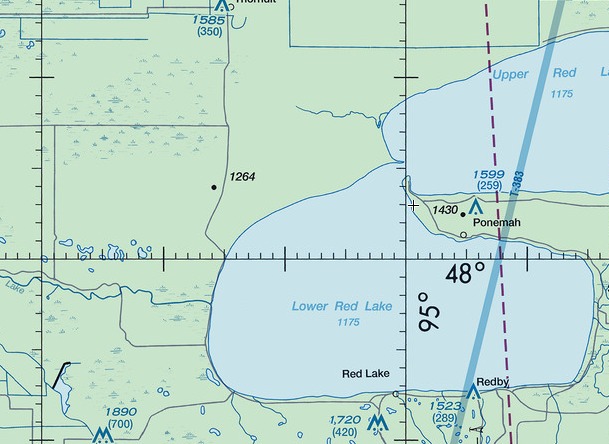

AOPA said Wednesday it is urging federal officials to assist in the recovery of a vintage airplane seized by the Red Lake Nation following an emergency landing on tribal land in northern Minnesota. In a letter sent December 17 to Transportation Secretary Sean Duffy and Interior Secretary Doug Burgum, AOPA President and CEO Darren Pleasance described the October 15 incident involving a 1946 Stinson 108 as a situation with broader implications for aviation safety.
Tribal impound basis
Smedsmo was en route to Bemidji Regional Airport when the engine failed at around 3,500 feet over Lower Red Lake. He managed to safely land on a road within the boundaries of the Red Lake Indian Reservation, but tribal authorities impounded the aircraft. The tribe cited its Resolution No. 59-78, a 1978 measure originally meant to fight back against a proposed military training route over the tribal territory. According to that measure, flight over Red Lake Nation lands is prohibited below 20,000 feet, although no such restriction is noted on federal aeronautical charts.
In a more recent public notice, the Tribal Council said the resolution remains active and called upon residents of the territory to report low-flying aircraft. The tribe later stated that Smedsmo’s landing occurred “without prior authorization or required coordination with Tribal authorities,” and therefore in its view raised “safety, liability, and resource-protection concerns.”
The tribe, which has its own territorial police and court system, has kept Smedsmo’s aircraft impounded since the landing.
AOPA response
In his letter, Pleasance questioned the legal foundation of the aircraft’s continued detention and wrote that the situation “raises serious concerns, as regulation of navigable airspace is a matter of exclusive federal authority.”
Federal aviation law grants the United States government sovereignty over domestic airspace and provides for a public right of transit. Current aeronautical charts depict a published T-route over the reservation, but do not indicate special-use restrictions.
AOPA’s letter called on both the Department of Transportation and the Department of the Interior to work with tribal leadership to clarify procedures for emergency landings.
“The continued detention of the aircraft not only imposes substantial financial harm on the owner,” Pleasance wrote, “but also sets a troubling precedent that could discourage pilots from making necessary emergency landings.”
The Red Lake Tribal Council has indicated its willingness to engage in discussions with federal authorities and confirmed that the matter remains under investigation.


This is an abomination! The airspace belong to the United States and the federal government has complete authority and sovereignty over that airspace. After the release of the plane, the owner should be compensated for his expenses and lost use time of the plane.
“ the United States and the federal government has complete authority and sovereignty over that airspace.”
Are Native American Indian Tribes a Sovereign Nation?
Tribal nations are recognized as sovereign governments in the U.S. Constitution, along with only three other entities: the federal government, state governments, and foreign governments. But tribal sovereignty is not based on the Constitution; it is an inherent right.
While not granted by the Constitution, I think it worthy to note that the Constitution does recognize those Nations.
Further still; Rights are not “granted” by the Constitution. Rights are Inherent and Inalienable-“self-evident”, if you will. No King or Constitution required.
Let’s see, indigenous people have lived on this continent for 15,000 years. White invaders from Europe arrived about 500 years ago. Who owns the airspace?
First answer - Are Native American Indian Tribes a Sovereign Nation?
Second answer - Tribal nations are recognized as sovereign governments in the U.S. Constitution, along with only three other entities: the federal government, state governments, and foreign governments. But tribal sovereignty is not based on the Constitution; it is an inherent right.
While not granted by the Constitution, I think it worthy to note that the Constitution does recognize those Nations.
My answer - Assuming Native American tribes have the same sovereignty as State governments, I think the question should be whether a State government would confiscate an aircraft after the pilot did an emergency landing in a State park.
My answer - The terms you refer to are part of the Declaration of Independence, not the Constitution, and have no standing under law.
.
This is one of those situations where it would be in the best interests of the Tribe to not push for a final settlement of the underlying principles. I would strongly recommend they release the aircraft and at least restate the Tribal flight ban in a way that makes more sense.
The special rights the Tribes enjoy within America were granted to assuage the guilt felt by the “invaders”, and there was definitely no intent to create actual fully independent countries within the USA. As such, they were crafted as much as possible to avoid areas likely to lead to this kind of direct conflict and trigger decisions that in turn could lead to unraveling the entire construct. You have to pick your battles.
Without the Declaration of Independence, the Constitution would not stand-We’d not then be separate from England, the Constitution would be moot.
Rights aren’t granted by law.
Rights aren’t granted. If a King or Constitution gives you something, it’s not a Right.
U.S. Courts have recognized the existence of natural rights. Indeed, the Fifth, Ninth, and Fourteenth Amendments to the Constitution are specifically about natural rights that are not enumerated. The Fifth and Fourteenth place a duty on the government to follow Due Process in its dealings with the people, and the courts have repeatedly cited them in cases regarding individual rights to privacy and family autonomy. The Ninth amendment explicitly protects natural rights that are not enumerated in the Bill of Rights.
Rights are indeed granted (see the definition of the word) and are only as “inalienable” as the guarantee that backs them. As humanity has always and continues to demonstrate daily in multiple ways, they may be ignored, taken away, or modified by whoever holds the power to do so.
I’m very interested in this document , law or statute that grants these “rights”
Bill of Rights is a good one to start with.
The subject of “rights” is an interesting one because, as seen in our back & forth, the word seems to have radically different meanings to different people, particularly those classified as “moral” or “natural” rights. With those, people often cite the beliefs of some religion as making that class of rights as being absolute and immutable, guaranteed to be upheld by every human being or human agency, but as we all know, that isn’t the case. Tied into this is that people often seem to think a right is something that continues to exist even when it is not observed, which I find odd because, well, if you have a right to life and some wacko comes up behind you & shoots you dead your right to live certainly doesn’t live on after you
There are many definitions of the word “rights.” Most differentiate between “natural rights” and “legal rights.” The Bill of Rights to the U.S. Constitution focuses mainly on natural rights–that is universal rights that inhere to each individual regardless of law. When courts rule on an issue surrounding individual rights they do not imply those rights are granted, rather they determine whether some governmental interest may take precedent. For example, the government has a national security interest that limits an individual’s natural right to move or speak freely.
The Bill of Rights does not grant the rights listed therein, it recognizes and protects them from government overreach. I’m flabbergasted that U.S. citizens do not understand the distinction between rights granted by some government vs rights inherent in each individual is the very foundation on which our government is based.
“ which I find odd because, well, if you have a right to life and some wacko comes up behind you & shoots you dead your right to live certainly doesn’t live on after you”
The wacko has forcibly removed me from my Right to life. He will be tried for not only removing that Right at the moment of death, but also any future Right to life that I may enjoy. Although I am no longer, the Right lives on.
The Bill of Rights does not read “you may”. It is written as a restraint on government, not as a grant to the people.
Almost every amendment is phrased as a prohibition, not a permission or grant:
“Congress shall make no law…
“shall not be infringed”
“shall not be violated”
“shall not be required”
“The people” are used as a holder, not a recipient. The People are owners, not beneficiaries.
Well, I think we’ve beaten this subject to death, so although it’s been enjoyable, I’ll depart with one final post.
I don’t understand the logic behind the idea that rights are not “granted” but exist independent of the societies or agencies that agree to provide and/or enforce them. While you may passionately argue that you have a right to, say, be unconditionally provided with free food and housing (a popular argument today), if the society in which you exist doesn’t agree and refuses to provide it, AKA grant it, then it would be more proper to describe it as an aspiration rather than a right.
To close, here’s my underlying belief about “rights”: There is only one universal or “natural” right that is granted to us, as it is to all life forms, by the universe in which we exist, and that is the right to try to survive in the environment in which we find ourselves using the tools at our disposal. ALL other “rights” we may think we may have are in fact only aspirations which may or may not be provided (granted) to us by our fellow humans.
A “Right” that requires another person’s labor is not a Right.
A true right can be exercised without forcing another person to act.
If that were not true, your “right” exists only if another person is compelled to serve you.
Food and housing are needs. Rights are moral limits on power.
When needs are declared rights, government gains the authority to seize property, compel labor and redistribute by force.
The scary thing here, is not that you believe the horse is dead to beat, but that you probably vote and there is some chance that you could be on a jury of someone’s peers.
I believe, all this discussion about rights and constitutions will not lead to anything! This dispute about overflying the reservation has been going on for decades! And the Natives have been ignored by the authorities for decades! It is time for a reasonable solution! I mean, why not recognise the wish of the inhabitants? What wrong with establishing a protected area like these bird sanctuaries in the south? They are asking for 20,000" - maybe they will also settle for 10… Case would be solved! And honestly, there is no need for any GA pilot to overfly this area! It is not that big, it is easy to fly around. Why not show some respect!