















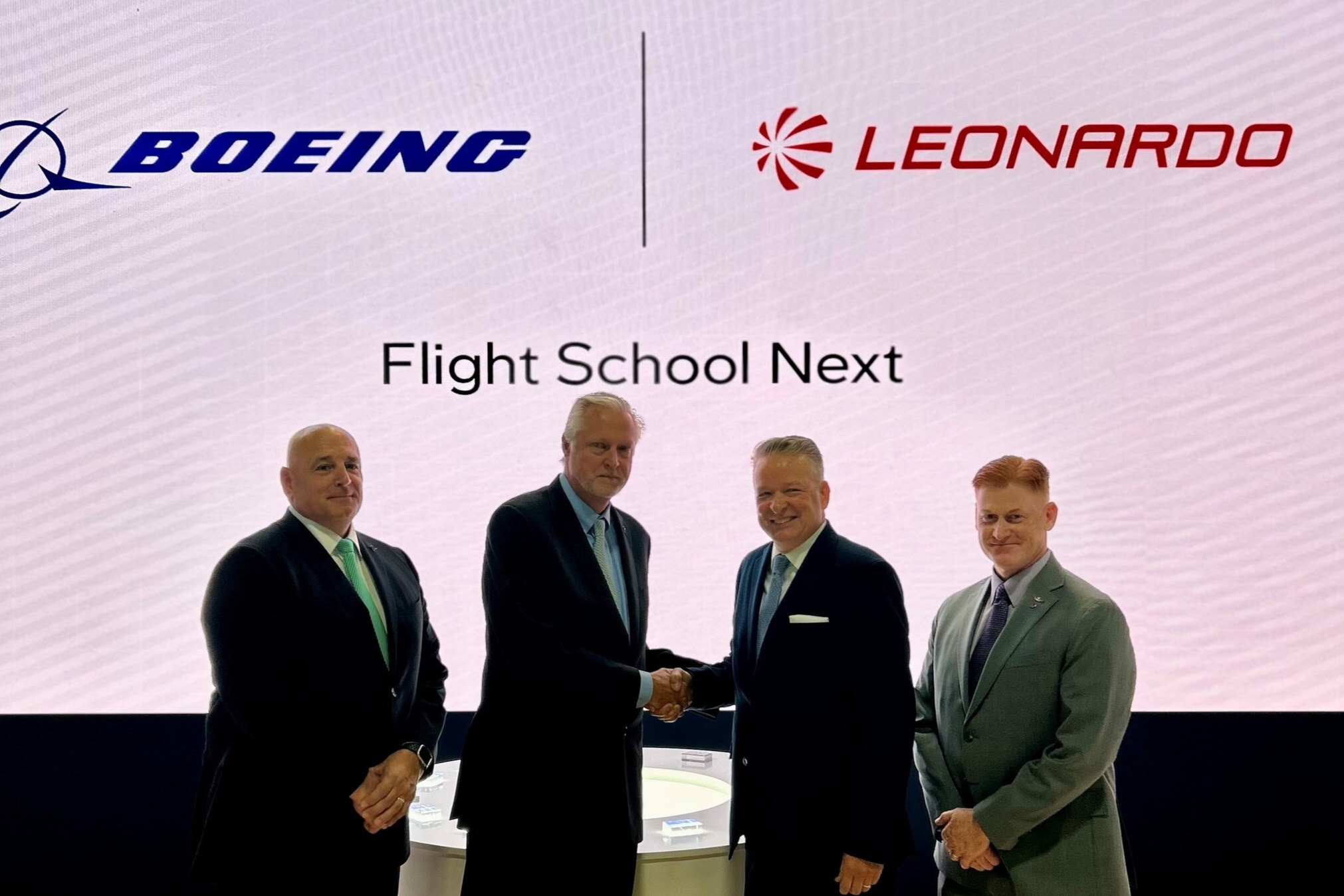

Boeing and Leonardo have announced a partnership to pursue the U.S. Army’s Flight School Next contractor-owned, contractor-operated (COCO) service contract. The agreement combines Boeing’s experience with Army rotary-wing training and program delivery with Leonardo’s AW119T training helicopter. The companies said the proposal is intended to provide a scalable training model to support future Army aviator requirements.
Flight School Next is part of a broader U.S. Army effort to modernize Initial Entry Rotary-Wing training at Fort Rucker, Alabama. Managed by Army Contracting Command–Redstone Arsenal, it is one of the largest contracts issued under a Commercial Solutions Opening, or CSO, competition. The program aims to shorten acquisition timelines and use commercial technologies to train between 900 and 1,500 pilots annually to Army and FAA standards. According to the Army, the CSO process is expected to reduce acquisition time by more than half compared to traditional methods and may serve as a model for future large-scale procurements.
We’re proud to join forces with @Leonardo_live to pursue the @USArmy's Flight School Next training contract. #AUSA2025
— Boeing Defense (@BoeingDefense) October 13, 2025
By pairing our extensive rotary-wing training expertise with Leonardo’s proven AW119T helicopter, we can offer a modern, efficient, scalable training solution… pic.twitter.com/Tj9uF6rdQh
As the U.S. Army looks to reduce costs and training timelines for its aviators, it also announced plans in September to reduce the total number of active-duty Army aviators by close to 6,500 jobs in fiscal years 2026 and 2027. It will do this in favor of a stronger emphasis on utilization of unmanned aircraft deployments.
Bell has also expressed its intentions to pursue the Flight School Next contract. The company has provided training aircraft to the U.S. Army since 1946 and continues to support pilot development through its Bell 505 training helicopter. The Bell 505, which has recorded more than 300,000 flight hours across 55 countries, features integrated avionics, a high-inertia rotor system and a cabin design intended to support student and instructor interaction. Bell’s proposal includes collaboration with industry partners such as TRU Simulation, DigiFlight, V2X, A1A and Delaware Resource Group, which specialize in simulation, instruction and maintenance support.
Boeing’s background includes training services and mission systems support for the AH-64 Apache fleet, incorporating live, virtual and constructive simulation programs.
“We are bringing together two industry leaders to offer the Army a turnkey, innovative approach to rotary-wing training with an integrated, long-term training solution that increases aviator proficiency, operational and sustainment efficiencies and will deliver measurable value throughout the life of the program,” said John Chicoli, senior director for U.S. Army, Marine Corps and Special Operations/Missions at Boeing Global Services.
Leonardo’s AW119T, a single-engine training platform with more than 100,000 accumulated flight hours, is currently used by the U.S. Navy for pilot instruction near Fort Rucker, Alabama.
“The AW119T is a proven platform that already supports U.S. military training every day,” said Clyde Woltman, CEO of Leonardo Helicopters U.S.
The proposal includes a training system with aircraft, simulators, instructors and maintenance support, along with logistics and scheduling systems designed to support training requirements over the course of the contract.


0 replies