















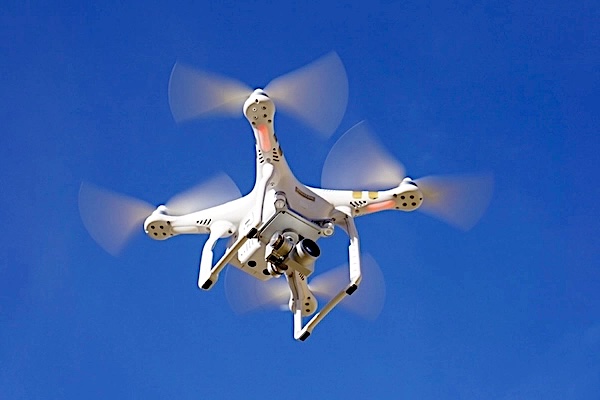

A rescue-and-recovery helicopter collided with a privately operated drone while conducting emergency flood-related operations near Kerrville, Texas, yesterday (July 7). The helicopter made an emergency landing and was out of service “until further notice.” The drone was flying in violation of a Temporary Flight Restriction.
In an official statement on Facebook titled PLEASE GROUND YOUR DRONES UNTIL CURRENT FLOOD SEARCH AND RESCUE OPERATIONS ARE COMPLETE, the city wrote: “This afternoon, a private drone illegally operating in restricted airspace collided with a helicopter involved in emergency operations in Kerr County. The helicopter was forced to make an emergency landing, and a critical piece of response equipment is now out of service until further notice. This was entirely preventable.”
The statement concluded: “Temporary Flight Restrictions (TFRs) are not suggestions. They are federal airspace rules designed to protect lives during emergency situations. When you fly a drone in restricted areas, you’re not just breaking the law — you’re putting first responders, emergency crews, and the public at serious risk.”


“1) ALL ACFT ENTERING OR EXITING THE TFR MUST BE ON AN ACT IFR OR VFR FLT PLAN WITH A DISCRETE CODE ASSIGNED BY AN AIR TFC CTL (ATC) FAC. ACFT MUST BE SQUAWKING THE DISCRETE CODE PRIOR TO DEP AND AT ALL TIMES WHILE IN THE TFR. 2) ALL ACFT ENTERING OR EXITING THE TFR MUST REMAIN IN TWO - WAY RADIO COM WITH ATC. 3) ONLY RELIEF ACFT OPS COORDINATED DIRECTLY WITH THE LISTED POINT OF CONTACT ARE AUTHORIZED TO LOITER IN THE AIRSPACE.”
TFR’s fail to explicitly ban birds or toys; it just just mentions “aircraft”.
So yea, a bird (or toy the size of a bird) are still in the area.
If you wanna ban toys and birds, then mention them in the TFR.
An aircraft is defined as any machine capable of flying, including those with or without a pilot on board.
Here we go again. Another Rhodes scholarship member, deciding to take it upon themselves to scout out the situation in an emergency area. Much like the police helicopter that hit a drone on a surveillance mission.
Except for ultralights which the FAA states are vehicles, not aircraft.
That’s not as true as it used to be. The FAA came out with a legal opinion that ultralights are indeed aircraft, and do not have the special privileges that might accrue from not being aircraft. Also, some TFRs, I think VIP TFRs, prohibit operation of anything airborne, including kites and model aircraft. I’ll let you look up the details.
Drones in navigable airspace has been a problem that continues unabated. While managing an international aviation activity 10+ years ago I experienced damage done to fixed and rotor wing aircraft from hobby drones. That damage was tied by our technicians to drones from the residual pieces remaining stuck in the airframes. The era of “big sky, little airplane” is over (not that it was ever true). There was a handful of damage events that we could not tie to drones but, due to the sharp angle damage, suspected.
It is well past the time to get ADS-B (or similar technology) on all drones or ground them. The user community has not demonstrated the necessary knowledge and commitment to flight safety to continue permitting these devices.
This is another instance of potentially avoidable death caused by a irresponsible drone operator? Whats the goal? Interrupting rescue and recovery operations? Footage for salviating Youtube/ Tiktok or Instagram consumers?
The FAA needs to find this person and JAIL them. Make an example!!! Prosecute and give the maximum sentence. Another person was operating a drone and hit the Mars tanker. How many more times does this have to happen before someone realizes it’s DANGEROUS and AGAINST THE LAW!!! When someone is killed?
PROSECUTE and publisize on ALL major networks. Make sure this ‘pilot’ gets JAIL time!
“An aircraft is defined as any machine capable of flying”
Per the TFR they must also have 2-way voice communications, and a transponder, and be on a flight plan. The flight plan part means that they are still defining aircraft as being registered and having registered pilots. That makes sense since the the FAA cannot regulate what they do not control.
Just saying that the TFR system was designed for manned aircraft; not for kites, toy copters, model rockets, arial fireworks, balloons, etc. Those things in uncontrolled airspace are controlled by local ordinances.
There was a case of an RCMP drone getting in the way of an RCMP helicopter in NW BC. Drone operator was not properly coordinated with helo. Helo landed OK and was airlifted away for maintenance/repair.
(Surveillance was of eco-scum obstructing construction of natural gas pipeline, at one point they attacked workers.)
During the disastrous flood event many helicopters extracted a large number of people.
A Coast Guard rescue swimmer was early on the scene, established two open locations for helicopters to land at, and prioritized evacuees (‘triage’). Some children had been outside wet for several hours.
Yeah, right. LOL. The TFR extends to the surface, so the underlying airspace is all controlled for the duration of the TFR. The phrase “ONLY RELIEF ACFT OPS COORDINATED DIRECTLY WITH THE LISTED POINT OF CONTACT ARE AUTHORIZED TO LOITER IN THE AIRSPACE” pretty much covers the entire restriction. You contradict yourself in your “expert” analysis of the TFR. Regardless, if there’s no transponder, FP, and no 2 way communication capability, the operation is prohibited in the TFR. Since a drone comes under the broad definition of “aircraft,” they are prohibited in the TFR unless those three conditions are met. It’s unfortunate that a TFR had to be issued in the first place, but stupid is as stupid does.
It’s been amazing; over 800 arial rescues in just 2 days.
FAR Part 107 defines operating limitations for both Commercial and Recreational drones. Neither are permitted to fly in controlled airspace or over Emergency Response Efforts without prior permission. This was clearly a violation of the operating rules unless the pilot had prior permission from the governing authority. Either way it is the responsibility of the drone operator to see and avoid other aircraft. A licensed drone operator would know this so it is likely this was a recreational drone operator. Recreational drone operators flying drone weighing less than 250g are not required to register them with the FAA. The result is that it is very difficult to identify the perpetrator and enforce these rules. The government makes lots of rules it can’t easily enforce. In the end it the responsibility of the individual to do the right thing. Unfortunately there are always folks that don’t care about following the rules. Drunk drivers and GA pilots that ignore FAA rules and the operation limitations of their aircraft come to mind. In the end it is the responsibility of all of us to hold our fellow pilots (and drone operators) accountable for their actions.
AJ said, “If you wanna ban toys and birds, then mention them in the TFR.”
Yeah, that’ll work, AJ. You think these morons read TFRs? They don’t even read the Owners Manual.
Brian H. thinks that the FAA should jail them. Um, the FAA doesn’t have the power to incarcerate, thankfully. Current events in major cities in the US demonstrate the danger of giving that power to too many governmental agencies.
And Bob quotes Part 107 placing the responsibility for see&avoid on the drone operator. Yeah, right. Try telling a 14-year old who just got a shiny new toy for his birthday, that he has to read the Owners Manual first. Forget about him reading any FARs, TFRs, SUA’s, and a myriad other boring acronymic minutia, before he can go out and play with his shiny new toy. “The box just says ‘outdoor use recommended’, and I’m outside, alright? Where else am I supposed to fly it?”
Birds are, generally speaking, not much of a risk to helicopters because they have excellent senses and an innate concept of self-preservation. And we make a lot of noise…
Toys, otoh, come with instructions that you have to “read” (ugh!) and should follow. (yeah, right…)
As a chopper pilot who rarely sees four-digit AGLs, I’ve been railing about this insidious and looming danger to rotorcraft for years, and not just in this forum. If I had my way, all such passenger-less aerial mines should have a shotgun shell bonded into their controllers, which is triggered by the drone’s contact with anything above 250’ agl. You wouldn’t have to blow the hands off of more than a couple of idiots before the rest of them start to take seriously the danger they pose to the rest of us.
In the olden days, we called it “Mutually Assured Destruction”, and it worked.
There was 'way more to that story than your “irrational” pejorative characterization, Keith
Totally agree with Drew’s comments. I have had two close calls with drones, one at the hold short line waiting for clearance with a drone hovering right in my path within 100 ft and another in the air where we missed colliding by less than 50 feet. “See and be seen” is useless policy when it comes to people irresponsibly flying drones in crowded airspace, especially around airports.
Everyone assumes ‘motorized’ flight but what about hot air balloons and kites. Those can get to a pretty good altitude so they need to be considered too. They can have cameras and be deployed by those trying to snoop around emergency situations! I’ve done it in the past for fun but not in a rescue environment!
Oh, I agree 100%. I hate these things being up where I’m flying too!
Point was that toy owners are not forced to read FAR’s or TFR’s and being out there in the relative wilderness and below 400’ are usually not any concern to pilots.
Let’s wait and see what news outlet or MUD district or local PD was out there with their drone before blaming the general public.
Dunno where you fly AJ, but around here it’s pretty rural and there are a LOT of farm strips, grass fields, and sleepy little county airports. Cubs, Champs, T-carts, and I rarely bother to climb up to 1000’ unless we’re going some distance. Fortunately, that also means that there aren’t that many kidiots (some full-grown) with such toys. It takes about a month for them to crash their Christmas presents, so I’m extra vigilant until February.
My problems have been when I needed to go to the big city. A start-up was testing drone food delivery for about a year. Thankfully, it was not successful.
Was that a forced landing or, precautionary landing?
Such as?
Reality is construction workers were attacked. Motivation was clearly ecological. That justifies my use of ‘scum’.)
Supposed ‘hereditary chiefs’ were involved, whereas elected chiefs supported the project.
If you know more of what went on say so, otherwise I know how to categorize you from past behaviour.
Caution for those accepting the initial report at face value. Chatter has been casting doubt on the suggestion of a private drone and the helicopter being out of service. Follow-up on this story is necessary. Details are emerging that Texas DPS lost a drone during an automated mapping mission (common search and rescue utilization of a drone) due to collision with a National Guard helicopter. This type of detail dramatically changes the picture of the incident as DPS operation within the TFR would have been allowed and that such a collision would show potential communication gaps in airspace management between the various disaster recovery responders. Stay tuned.
I respectfully and vehemently disagree, UAS_Legal.
A drone carrying no living thing collided with a piloted aircraft carrying humans. This should never be allowed to happen, and renders irrelevant who owned the drone, what its mission was, or whether it was legally in that airspace. It was as invisible a threat to human life as a bullet. The points you offer in no way “dramatically changes the picture of the incident”.
To human-piloted aircraft, drones are essentially invisible, turning them into “air mines” that cannot be avoided.
Unless and until drones acquire the sensory ability to avoid all other aircraft (as all human-piloted aircraft do naturally) they should not be allowed in any airspace with piloted vehicles. Period.
I do, as do quite a few other people, Keith. But a) this is not the forum to discuss it, and b) your use of pejoratives makes it clear that you do not possess a mind even remotely open to discussion.
‘Aviatrexx’:
ROFL, you are ducking.
As I’ve said, your behaviour record is important.
Thankyou for that.
Similar to RCMP drone colliding with own helicopter in NW BC.
Local police need to be watching.
There are ways to disable, identify source, and crash UAVs (but in fire prone areas crash could start a fire).
But, as you noted, the problem is that it’s impossible to hold drone operators accountable if you can’t find them. My understanding is that authorities are searching for the one responsible for the downed Kerrville helo, but that may never happen.
Also, as another poster mentioned, a lot of the recreational drone activity is not for personal edification, it’s for social media “clicks” for notoriety, attention, and validation, with “influencer” status as their ultimate motivation. For most of them, no laws, rules, or TFRs will stand in their way. Some of them have killed themselves attempting stupid stunts just for “clicks”. It’s a sad commentary on the status quo of our younger people today.
And I suggest taking such “chatter” with a HUGE grain of salt. Self-styled experts on social media inevitably pop out of the woodwork with their “theories” about what happened, and they’re usually way off the mark.
WRT the “details emerging” that it was a lost DPS drone that hit the helicopter, there are no such reports from any legitimate sources on the web, which is instead literally FULL of accounts that it was a privately-owned drone involved. If it had been a DPS drone, DPS would be acknowledging it. They haven’t.
Police on the street are needed.
A few publicized cases of nabbing for reckless endangerment should slow the risk.
IIRC the juurk who hit a CL water bomber near LA got a heavy fine and paid damages, if not jail time, and the event was publicized
Drones need transponders and TCAS; when in an emergency area. Tell the FAA: no one flies drones in an emergency area without a Transponder and TCAS. And all others, stay out; usually by NOTAM. Separation in uncontrolled airspace will always be a challenge!!! We love our uncontrolled airspace, so no discussions on getting rid of it. Will bring down every aviation organization on Earth on who ever even makes such a suggestion!