














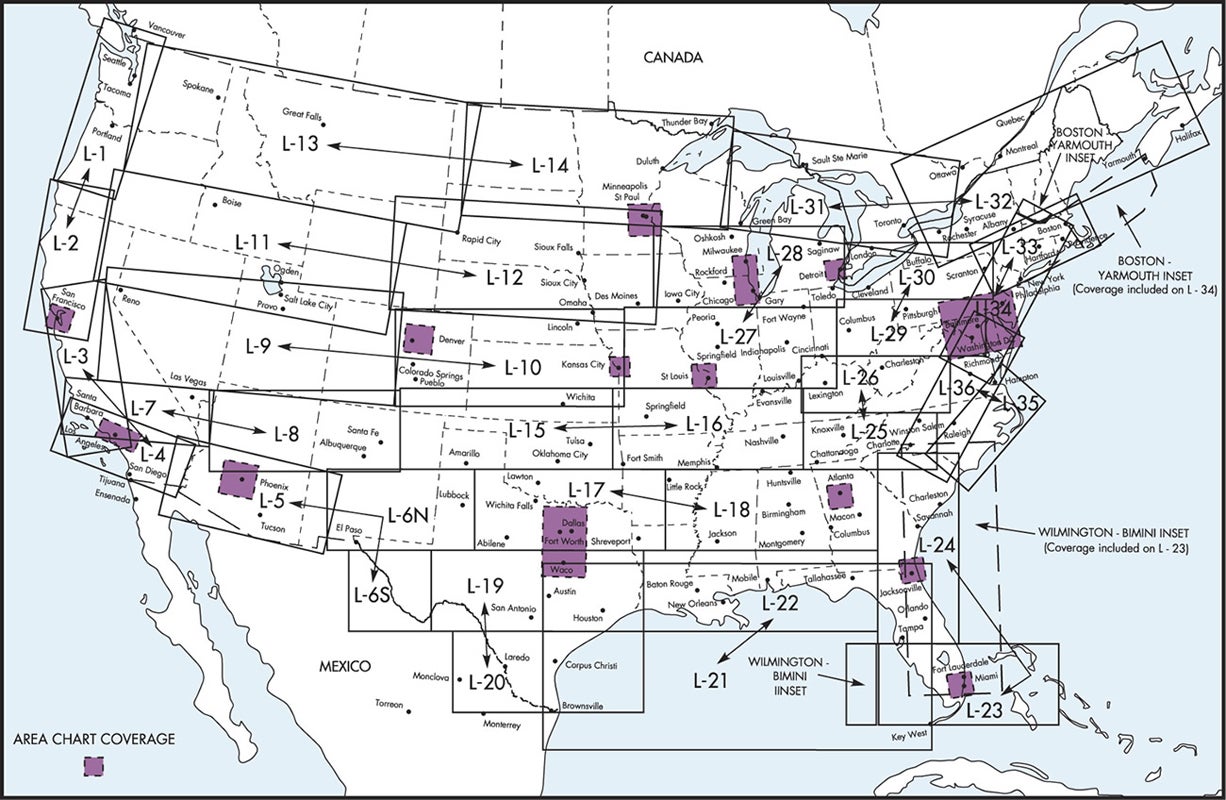

Starting with the June 15 release, FAA enroute IFR charts, low and high altitude, will lack much of the customary flight information in foreign airspace bordering the U.S. The decision was announced in a May 23 Charting Notice and publicized by the FAA on Saturday in a safety memo to a subscriber list. The agency did the same thing, which it termed “skeletonizing,” for VFR charts earlier this year and is citing the same reason for expanding the effect to the IFR world.
“The FAA does not reliably receive foreign data with sufficient lead times to produce the foreign areas of FAA charts with the same robust, for navigation, content as within U.S. airspace,” the agency said in a statement. “Additionally, foreign aeronautical information is not supported by the U.S. NOTAM System.” Those who need the information for flying to or transiting Canadian, Mexican and Caribbean countries’ airspace that borders the U.S. will have to get detailed charts from the providers in those countries.
When the VFR charts were skeletonized, all that remained for foreign areas on the charts were major airports, NAVAIDs and airways. It’s not clear what will be left on the IFR charts. Some areas affected get a lot of U.S. traffic that is destined for U.S. destinations because the shortest way is to overfly foreign airspace. “Charted information in foreign areas is only provided for the purpose of orientation and transition to charts and publications of other countries,” the Charting Notice says. “This change will make clear that the intent of U.S. Charts for navigation within domestic airspace and that charts of other countries should be used within their respective airspace.”
