














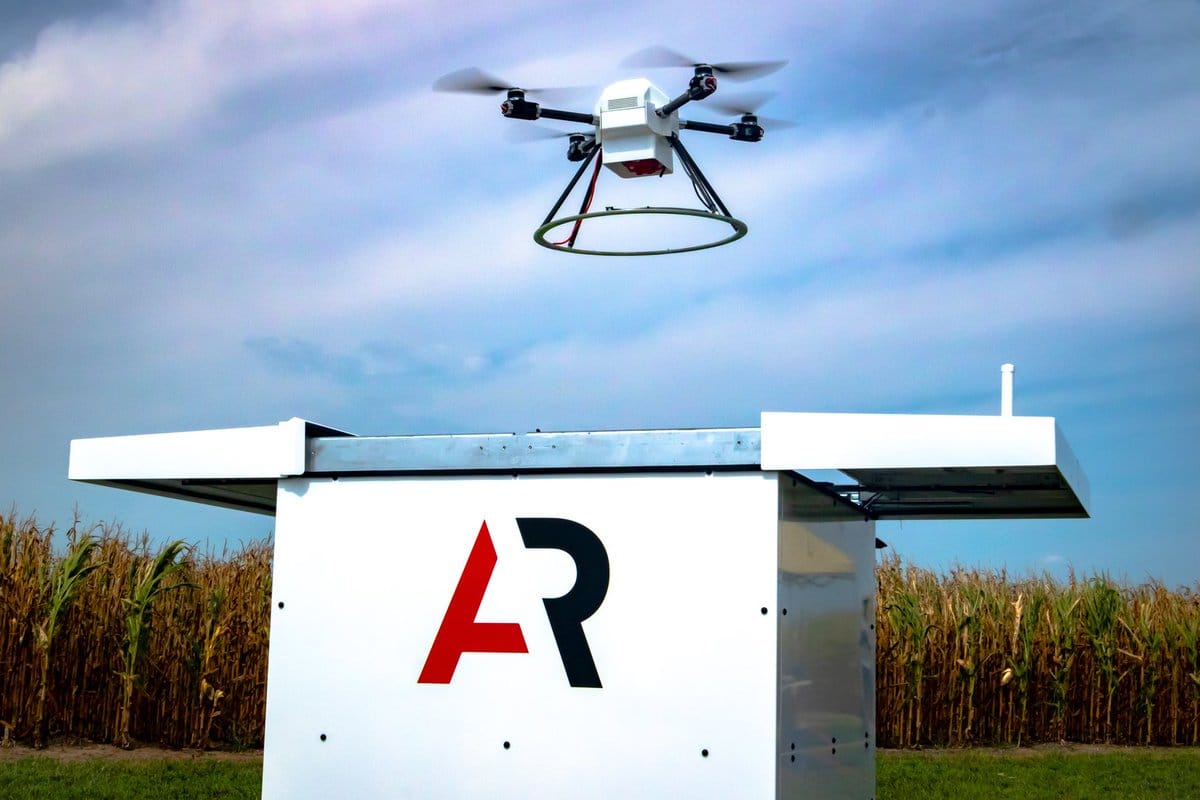

The FAA has allowed a Massachusetts company to conduct the first truly autonomous beyond visual line of sight (BVLOS) drone operation in the National Airspace System (NAS), opening the door to a wide range of commercial applications. American Robotics is now allowed to fly drones weighing up to 20 pounds in rural areas without a human observer or pilot nearby. In fact, the pilots might be thousands of miles away. “For example, with our approvals, we are able to install Scout systems in Nevada and Kansas, and remotely operate them from Boston, MA without needing local pilots or visual observers (VOs),” American Robotics CEO Vijay Somandepalli told Avionics International.
The drones are stored and launched from small charging bases and a series of ground-based microphones along the drone’s planned route provide acoustical information on the location of potentially conflicting aircraft. The detect and avoid (DAA) system can hear other aircraft several miles away and monitor it to ensure safe separation is maintained. “The ground-based acoustic DAA technology we use in the Scout system is able to detect and track aircraft out to several miles even at low altitudes where other traditional sensors such as radars struggle with issues like clutter,” Somandepalli said. “The entire Scout system has undergone rigorous and extensive testing and validation in the field in real-life conditions to ensure that it can operate safely and harmoniously in the NAS with other aircraft.” The system is limited to having a remote pilot dedicated to each operating drone but the next step is to have multiple drones in the air under the supervision of a single distant pilot.
