















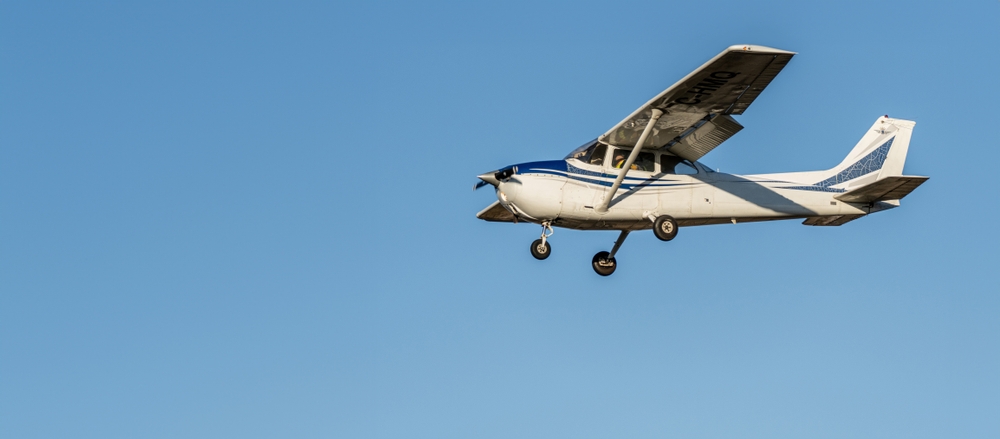

Manistee County/Blacker Airport in northern Michigan will begin charging visiting general aviation aircraft new airfield activity fees Oct. 1 following approval by the Manistee Blacker Airport Authority on Aug. 17. According to the airport’s FY2027 rates and charges schedule, aircraft weighing less than 6,000 pounds will pay $10, while aircraft from 6,000 pounds to less than 12,500 pounds will be charged $30.
Fees Scale With Aircraft Weight
The schedule sets fees at $75 for aircraft weighing at least 12,500 pounds, $110 at 25,000 pounds, $150 at 50,000 pounds and $200 at 75,000 pounds. Helicopters will be charged $25.
Based aircraft, military and government aircraft, Angel Flight and medevac operations and touch-and-goes are exempt. The fees are scheduled to increase annually through fiscal year 2031, subject to Airport Authority approval.
Orchard Beach Aviation will collect the charges from applicable aircraft that park on the apron and whose pilots exit the aircraft, as well as aircraft receiving FBO services. Purchasing fuel does not eliminate the fee.
Airport Director Miles Weaver said in an August memorandum that staff reviewed the airport’s operating budget and rates at comparable airports while developing the schedule.
“All stakeholders of the airport must share in the investment of the airport,” Airport Authority Chair Dyllan Walker wrote in a response reported by AOPA.
Walker said Manistee’s local investment in the airport has increased in recent years and argued that comparisons with other airports have limited value because airports operate under different financial circumstances.
AOPA Questions Fee Structure
AOPA said it has requested that the authority postpone new charges while it provides additional information about how the fees were calculated. The organization said Manistee recorded 3,749 operations in 2025, which included primarily GA traffic. AOPA also questioned whether the fees are supported by an appropriate allocation of airport costs. AOPA said it was awaiting a response to its request as of Thursday.


Another case where they think they’re going to make up costs, and it will cost them. No doubt the airport receives fuel flow age fees and fees from FBO charges. Start charging for landings, now discretionary trips (training, fuel stops, etc) pick other airports. So whatever the airport makes in landing fees is lost to lost revenue to the FBO (and pass through revenue to the airport authority).
You cannot assume, for a GA airport, that operation levels with remain the same after you implement a landing fee. It would be interesting to see what the net income to airport authority is after a year of this, as well as any loss of income to the FBO from transient aircraft
MBL is an essential air service airport and gets paid for every Part 121 seat that arrives. It also receives AIP money to maintain the airport. A $10 penalty for flying into Manistee will not break me, but I will lose the convenience of flying up from Ann Arbor to visit my good friend’s home there and hopping on a bicycle to his house. Fortunately, there are a number of very nice, friendly airports close at hand, and I guess we’ll get supper in Ludington instead of the Manistee restaurants. The problem with the operators of EAS airports is they think they are ORD or DTW, when in fact they are primarily GA airports who would not exist at all but for GA taxes and operations. A fee here, a hassle there, and pretty soon the ramp is empty and if that happens it will be along time to recover as habits change. I’ve seen thriving GA airports turn into ghost towns just across the lake when they start down this road and even if they reverse course, it doesn’t come back. I shall miss MBL. It was a nice airport.
They have been charging fees for a long time. The terminal was ‘moderinzed’ for a 121 operation, which folded (maybe Midwest Express). I landed there one day for lunch about 18 years ago in my Baron. I was given a choice of buying fuel (if I remember correctly at least 25 gallons) or paying a fee. I put 12/5 gallons per wing. That was the last time I flew in there.
Just another airport to avoid now. These money-grubbing bureaucrats think GA pilots are a bottomless pit of money.
These “fees” being charged by “municipalities” is nothing more than yet another “tax” on ‘We the People’. While it would be easy to casually throw out the phrase “taxation without representation”, the pernicious effect of all these “fees” is that ‘We the People’ are progressively being taxed into oblivion. More and more, we will become Serfs to the tax collectors.
Another example of this “taxation without representation” is when an older homeowner pays Property Taxes on real estate property, that they have completed paying the full mortgage on, but is required to pay a contractor to repair natural occurring seasonal weather damage to the sidewalk in front of their home.
Perhaps a more thorough analysis into the operating practices of these municipalities to discover inefficiencies would serve ‘We the People’ better.