














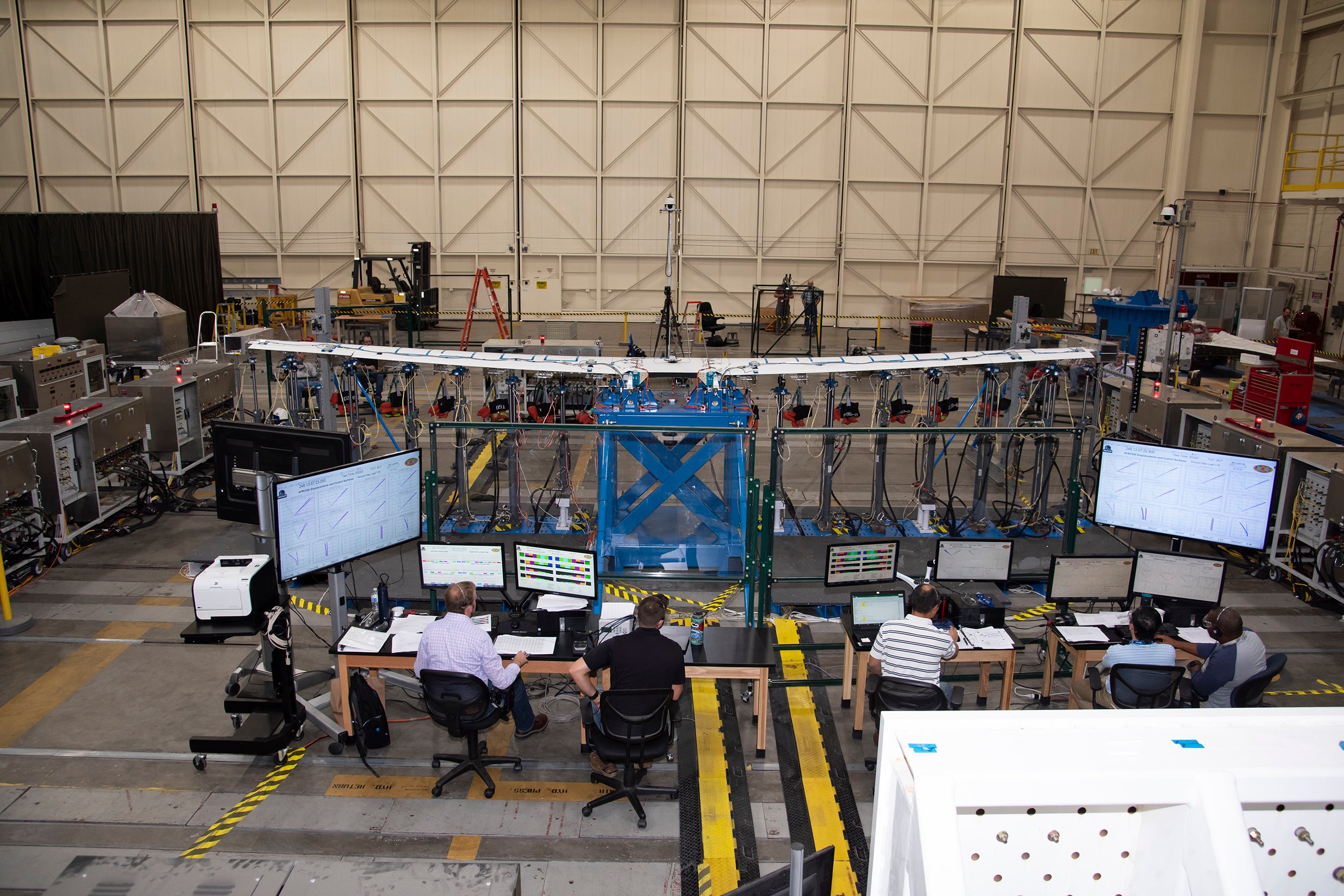

NASA has successfully completed testing of a new high-aspect ratio wing for its X-57 Maxwell all-electric research aircraft. The goal of the wing tests, which took place at NASA’s Armstrong Flight Research Center in California, was to “calibrate installed strain gauges for real-time loads monitoring and to verify the wing has met design specifications.”
The X-57 Maxwell—a modified Tecnam P2006T—has been undergoing a series of phased modifications (“Mods”) in preparation for the aircraft’s first flight. The Mod III version of the new wing allows the electric motors to be repositioned to the wingtips while the Mod IV design will include 12 additional smaller motors. As previously reported by AVweb, the wing was delivered by contractor Empirical Systems Aerospace (ESAero) last June.
At Armstrong, the Mod III/IV wing underwent structural load tests, evaluation of control surface freedom, weight and balance measurements, and ground vibration testing. Once testing was complete, an ultrasonic inspection was conducted to verify the wing’s condition. Next, the wing will be shipped back to ESAero for integration with a “nearly identical” P2006T fuselage in preparation for its eventual use on the Maxwell. According to NASA, the X-57 is “intended to demonstrate the benefits electric propulsion may have for efficiency, noise and emissions.”
