














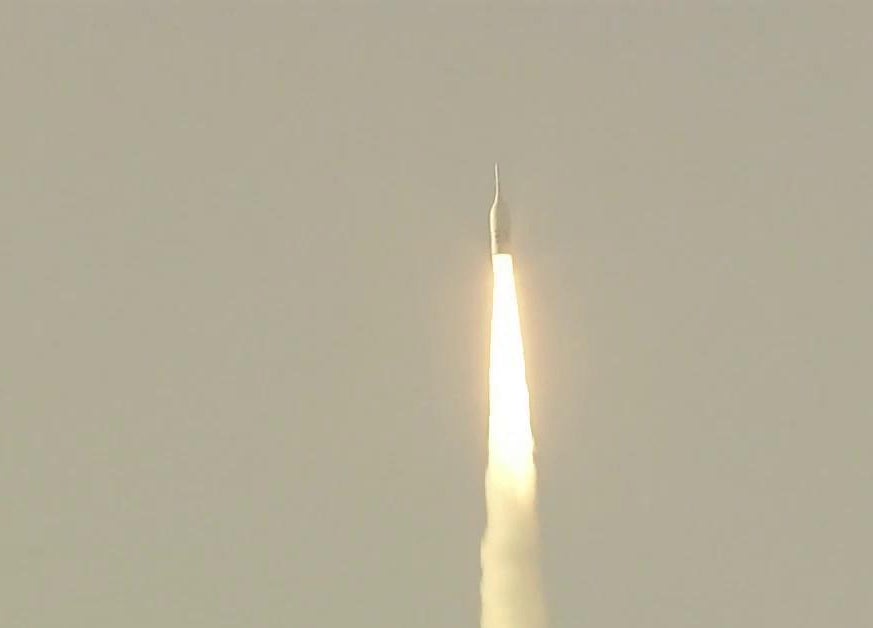

NASA completed a successful test of the launch abort system (LAS) on its Orion spacecraft at Florida’s Cape Canaveral Air Force Station on Tuesday. The Ascent Abort-2 (AA-2) test involved launching a test version of the Orion crew module on a modified Peacekeeper missile to an altitude of approximately 31,000 feet, at which point the abort sequence was triggered. The LAS uses an abort motor to pull the crew module away from the rocket, an attitude control motor to orient it and finally a jettison motor to release the module. The three-minute test was conducted in preparation for NASA’s Artemis missions, which have been planned with the goal of returning astronauts to the lunar surface by 2024.
“Launching into space is one of the most difficult and dangerous parts of going to the Moon,” said Orion program manager Mark Kirasich. “This test mimicked some of the most challenging conditions Orion will ever face should an emergency develop during the ascent phase of flight. Today, the team demonstrated our abort capabilities under these demanding conditions and put us one huge step closer to the first Artemis flight carrying people to the Moon.”
According to a NASA fact sheet on AA-2 (PDF), the test “provides the only opportunity to test a fully active launch abort system during ascent before flying crew.” The agency also stated that it elected to accelerate the test schedule and reduce testing costs by “simplifying the test spacecraft and eliminating parachutes and related systems.” The parachute system was separately qualified for crewed missions via a series of 17 developmental and eight qualification tests that was completed at the end of 2018.
